
Electrostatic discharge (ESD) poses a hidden but serious threat to modern manufacturing. Even a tiny spark—too small for humans to feel—can damage chips, corrupt data, or reduce product reliability.
For industries handling sensitive electronic components, every piece of mobile equipment must be designed to safely release static electricity.
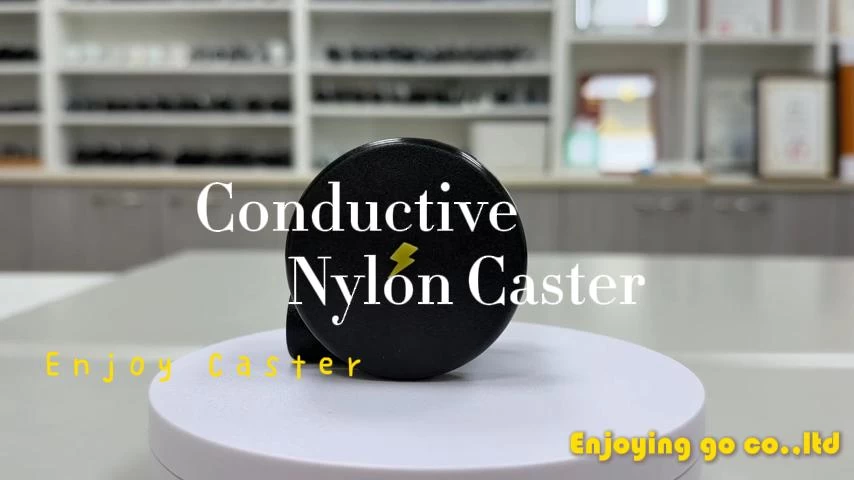
Conductive casters (ESD casters) play a critical role in this system, ensuring that carts, tool racks, and movable fixtures maintain a continuous grounding path while in motion.
Below are the top five industries where conductive casters are not optional, but essential.
1. Semiconductor Manufacturing (Wafer Fab & IC Packaging)
Semiconductor wafers and integrated circuits are extremely ESD-sensitive.
A single uncontrolled discharge can destroy microstructures or degrade long-term chip performance.
Common factory equipment requiring conductive casters:
● Wafer carriers
● Material trolleys
● FOUP/reticle transfer carts
● Tooling and inspection carts
In high-precision semiconductor environments, conductive casters help maintain controlled, predictable grounding to prevent high-voltage build-ups during movement.
2. PCB Assembly and SMT Production Lines
PCB boards, BGA components, sensors, and optical modules all have low tolerance for ESD.
Because SMT factories rely heavily on internal logistics, moving carts are a major ESD generator.
Conductive casters are used on:
● SMT feeder carts
● Reflow/inspection carts
● WIP racks
● ESD-safe tool carts
By providing continuous conductivity, these wheels ensure the entire line maintains stable electrostatic control from station to station.
3. Optical Electronics and Display Panel Manufacturing
Products such as:
● Camera modules
● Optical lenses
● LCD / OLED modules
● Touch panels
All involve fragile thin-film components highly vulnerable to static discharge.
Conductive casters help prevent electrostatic accumulation during:
● Lens transport
● Panel movement
● Module assembly
● Cleanroom material handling
For optical factories, stable grounding protects both component quality and yield rate.
4. Server, AI Hardware, and Data Center Assembly
The rise of AI accelerators, GPU servers, and hyperscale data centers has increased the demand for static-safe handling equipment.
Conductive casters are essential for:
● Server rack assembly carts
● Testing and burn-in transport
● High-value component carriers
● Workstation and wiring carts
ESD-safe casters reduce risks while installing SSDs, processors, memory modules, and power units.
5. Medical and Laboratory Equipment Manufacturing
Many medical devices include embedded electronics, sensors, chips, and microcontrollers.
Static discharge can affect device calibration, firmware stability, or internal circuit reliability.
Conductive casters are widely used on:
● Device assembly carts
● Instrument transport carts
● ESD-safe lab trolleys
● Diagnostic equipment platforms
These wheels ensure accuracy and equipment reliability in both cleanroom and controlled lab environments.
Why Conductive Casters Matter Across These Industries
Regardless of the application, the purpose of conductive casters is the same:
● Provide a low-resistance path to ground
● Prevent voltage spikes
● Reduce product damage
● Improve production yield
● Maintain ESD-safe compliance
In high-value manufacturing environments, a single broken chip often costs far more than the caster wheel itself—making ESD-safe mobility a critical investment.
Conclusion: Conductive Casters Are a Core Part of Every ESD Control System
From semiconductor fabs to AI hardware assembly, conductive casters protect the entire production chain.
They ensure that every piece of mobile equipment—no matter how simple—supports a safe, stable, and ESD-controlled environment.
If your factory requires verified ESD-safe caster solutions, customized resistance levels, or OEM support, the Enjoy Caster team is ready to assist.