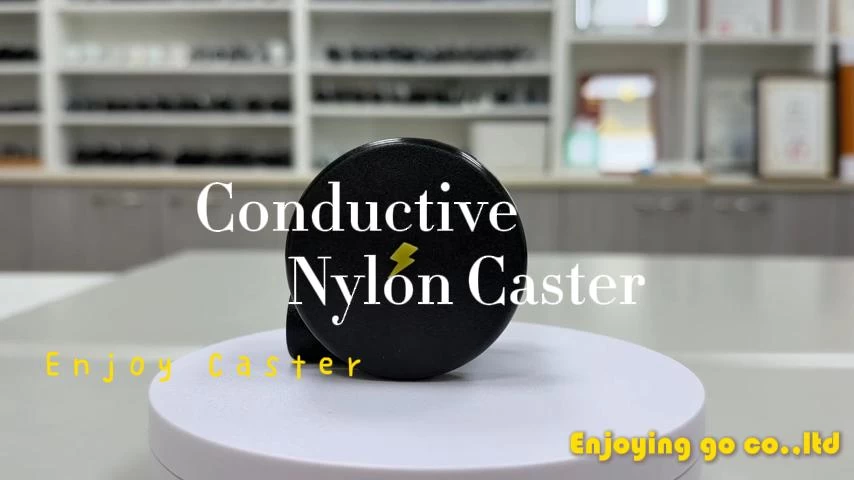
If your SMT lines, semiconductor tools, or server assembly carts need reliable static control from the ground up, contact Enjoy Caster to review our conductive nylon caster specifications, resistance data, and OEM options tailored to your ESD standards.
Static electricity (ESD) is one of the most underestimated yet most costly risks in modern electronics production.
Taiwan, being one of the world’s most important hubs for semiconductor fabrication, IC packaging, PCB production, optical electronics, and server assembly, relies heavily on mobile carts, jig carriers, tool racks, and transport equipment inside every plant.
Whenever these devices move, friction generates static charge. If the charge is not discharged safely to the ground, it can lead to product failure, yield loss, or permanent chip damage.
This is why conductive casters are essential in every electronics manufacturing environment.
Below is a clear explanation of how conductive caster wheels prevent ESD-related failures and why electronics factories rely on them.
1. Why ESD Can Damage Electronic Components
Electronic components such as ICs, chips, and PCBs contain extremely sensitive microstructures. A single discharge—even one too small for humans to feel—can permanently damage a component.
Common ESD sources in factories include:
● Operators carrying static charge
● Material carts are generating friction while moving
● Equipment contacting ungrounded surfaces
● Tooling and fixtures with no discharge path
● Floor-to-wheel friction builds up electric potential
The purpose of conductive casters is simple:
Create a continuous conductive pathway to ground before static builds up into a harmful discharge.
2. How Conductive Casters Work: The Core Mechanism
Conductive wheels contain carbon-based compounds to lower electrical resistance.
This creates a safe path for the accumulated charge to flow to the floor’s grounding system.
Electrical discharge path:
Equipment frame → Bracket → Conductive wheel → Grounded floor
Once a stable path is formed, static electricity is continuously released, preventing dangerous voltage spikes.
3. Why Electrical Resistance Matters Most
Electrical resistance is the key specification for any conductive caster.
Enjoy Caster Conductive Nylon Wheel – Internal Test Results
Measured resistance range:
● 1K to 100K ohms
● Equivalent to 10³ to 10⁵ ohms
This range ensures safe, controlled, and stable ESD discharge suitable for most electronics manufacturing cleanrooms.
Industry Comparison
Typical conductive nylon wheels:
● 1K to 1,000K ohms
● Equivalent to 10³ to 10⁶ ohms
Enjoy Caster’s nylon conductive formulation maintains a more stable, narrower, and safer conductivity window for high-sensitivity applications.
4. Why Electronics Manufacturing Requires Conductive Casters
1. SMT, PCB, and IC Packaging Lines
Transport carts move constantly between stations, making them a major static source.
Conductive casters ensure each cart maintains reliable ground contact.
2. Semiconductor, Optoelectronics, and Precision Assembly
Chips, sensors, optical modules, and micro-devices are highly sensitive to ESD.
Conductive wheels keep voltage differences under control during movement.
3. Server Assembly, Data Center Hardware, and AI Equipment
Racks and carts for server components generate friction easily.
Conductive casters reduce ESD risks during installation and internal transfer.
4. Standard Requirement in Taiwan’s Electronics Factories
In Taiwan’s electronics ecosystem—semiconductors, panel makers, EMS, server suppliers—
conductive casters have become mandatory for nearly all factory carts, tool racks, and movable fixtures.
5. Why Choose Enjoy Caster Conductive Nylon Casters?
● Stable conductive performance unaffected by moisture
● Electrical resistance maintained within an optimal ESD-safe range
● Designed specifically for electronics, semiconductors, and precision production
● Full internal resistance data available for customer audits
● Manufactured by a caster specialist with strict quality and material control
Enjoy Caster conductive nylon casters are not only compliant—they are engineered to enhance real-world ESD safety.
Conclusion: A Small Component That Protects the Entire Production Line
In electronics manufacturing, yield, device reliability, and customer trust all depend on proper ESD management.
A high-quality conductive caster helps:
● Prevent component failure
● Improve production yield
● Reduce repair and scrap costs
● Enhance global customer confidence
Conductive casters may appear small, but they play a critical role in safeguarding high-value products across the entire facility.