
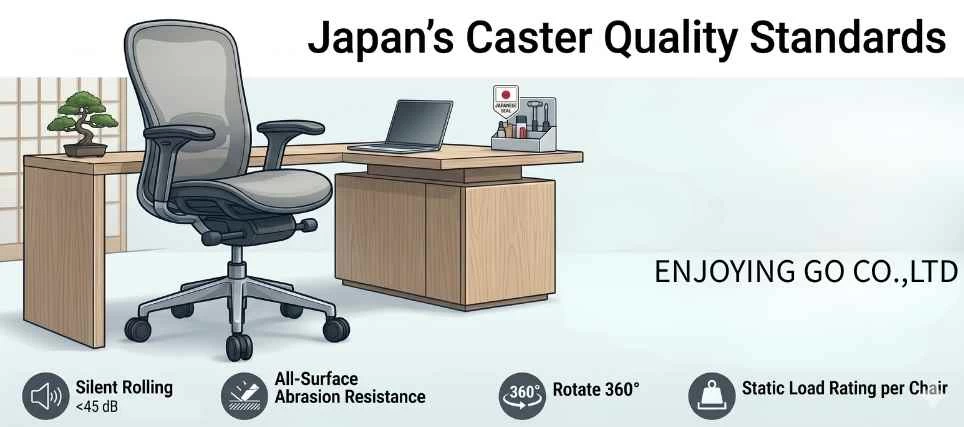
Japan's Caster Quality Standards: What Global Suppliers Need to Know
|
★ Key Takeaways |
|
Japan's caster quality requirements exceed global norms in three areas: noise performance, dimensional precision, and long-term reliability. |
|
Office chair casters are the highest-scrutiny category — rolling noise is one of the top reasons Japanese buyers reject suppliers. |
|
This guide breaks down Japan's five quality thresholds and how Enjoy Caster meets each one. |
|
★ Enjoy Caster will exhibit at ORGATEC Tokyo, June 2–4, 2026 — come experience the difference in person at Booth S1-J03. |
Why Are Japan's Caster Quality Standards So Demanding?
Japan is one of the world's most quality-sensitive markets for office furniture components. This is not purely cultural — it reflects the industrial structure of Japanese furniture manufacturing, where brands compete on craftsmanship precision (Monozukuri) and pass those expectations directly to component suppliers.
For caster manufacturers, the barrier to the Japanese market is not price. It is the ability to consistently meet quality expectations that often exceed those specified by European or North American buyers.
Japan's 5 Caster Quality Thresholds
Threshold 1: Noise Performance — The Non-Negotiable
Japanese office environments are exceptionally quiet. Caster rolling noise on hard flooring is a primary evaluation criterion — Japanese buyers typically require below 40 dB on standard hard-surface tests, compared to the 45–50 dB standard common in European and North American procurement.
Rolling noise originates primarily from the wheel material itself. High-quality PU compound absorbs surface vibration and significantly reduces rolling noise — making PU the proven material choice for consistently meeting Japan's strict acoustic standards.
Threshold 2: Dimensional Precision — Japan's "Just Right" Tolerance
Japanese buyers apply extremely tight tolerances to caster stem fit, wheel gap consistency, and axle alignment. Deviations that would be accepted in Western markets are often grounds for sample rejection in Japan.
Enjoy Caster's patented two-shot injection molding forms both PU shell and plastic core simultaneously in a single cycle, delivering structural precision that far exceeds two-step manufacturing — meeting Japan's tolerance requirements consistently across production runs.
Threshold 3: Long-Term Reliability — Not Just Initial Quality
Japanese buyers and end consumers place enormous weight on sustained performance over years of use. Initial sample quality is necessary but not sufficient — casters must maintain consistent rolling resistance and zero PU delamination over a 5+ year product lifespan.
|
★ Why Enjoy Caster Offers a 5-Year Warranty (vs. the Industry Standard of 1 Year) |
|
Standard process: PU bonded to core in two steps → adhesive-dependent → delamination under sustained use |
|
Enjoy Caster: Patented single-cycle two-shot injection → molecular-level PU-core bond → no peeling, 5-year warranty |
Threshold 4: Floor Protection — From Tatami Consciousness to Modern Office Floors
Japan's deep-rooted floor protection awareness extends into modern commercial environments. Casters that leave marks or indentations on Japanese hardwood, PVC, or stone flooring generate immediate complaints and returns.
Soft-formulation PU compounds distribute contact pressure across a larger surface area, making them the standard solution for Japanese floor-safe caster specifications.
Threshold 5: Surface Finish & Visual Consistency
Japanese furniture brands maintain meticulous visual consistency across product lines. Surface gloss uniformity, color consistency, and logo embossing clarity are evaluated during sample sign-off — not as secondary details but as primary acceptance criteria.
Enjoy Caster supports custom logo embossing and color matching to assist Japanese brand partners in maintaining full visual alignment across their product ranges.
Japan vs. Western Market Caster Standards: Comparison
|
Quality Criteria |
Japan Market |
Europe / North America |
|
Noise threshold |
< 40 dB (very strict) |
< 45–50 dB |
|
Dimensional tolerance |
Near-zero tolerance |
Standard tolerance accepted |
|
Long-term reliability |
5+ year verified stability |
1–3 year warranty typical |
|
Floor protection |
Zero marks, highly sensitive |
General requirement |
|
Visual consistency |
Surface detail scrutinized |
Function-first |
|
Certification reference |
SG Mark, JIS standards |
BIFMA (US), EN (EU) |
Enjoy Caster's Track Record in the Japanese Market
Understanding Japan's quality standards is one thing. Having those standards validated by actual Japanese customers is another. Enjoy Caster has an established base of Japanese office furniture and home furniture brand clients, with consistent ongoing export to the Japanese market.
|
★ Why Japanese Buyers Choose Enjoy Caster |
|
• Products have passed rigorous Japanese buyer sample qualification — noise performance, dimensional precision, and visual consistency |
|
• Proven Japan export experience: familiar with Japanese procurement processes, documentation requirements, and inspection standards |
|
• Long-term partnerships: quality consistency that drives repeat business, not one-off transactions |
|
• Full OEM/ODM capability: color code matching, logo embossing, and packaging customization to Japanese brand specifications |
This track record means Enjoy Caster is not simply a manufacturer that claims to meet Japanese standards — we are a supplier already validated by the Japanese market.
Frequently Asked Questions (FAQ)
Q1: Can Taiwan-manufactured casters meet Japanese JIS standards?
A: Yes — but suppliers must proactively provide supporting test documentation. Japanese buyers typically do not mandate JIS certification for imported components, but they will require noise test reports, durability test data, and material safety documentation for internal review. Enjoy Caster holds BIFMA certification and can provide test data aligned to Japanese buyer requirements.
Q2: How does the Japanese furniture procurement process differ from Western markets?
A: Japanese procurement cycles are longer and sample qualification is more rigorous — often requiring 2–3 revision rounds. However, once a supplier passes qualification and becomes a registered vendor, the relationship is highly stable; supplier switching frequency is far lower than in Western markets. Patience through initial qualification is the single most important market-entry strategy.
Q3: Do Japanese OEM buyers have special customization requirements?
A: Yes. Japanese brands typically require exact color matching to chair frame specifications, high-clarity logo embossing to defined standards, and sometimes Japanese-language product labeling on packaging. Enjoy Caster provides full OEM/ODM customization capability to meet these requirements.
Q4: What is SG Mark certification and does it matter for casters?
A: SG Mark (Safety Goods Mark) is a voluntary Japanese safety certification issued by the Japan Product Safety Association (JPEN) under the Consumer Product Safety Act. For suppliers targeting the Japanese consumer market, SG Mark provides significant credibility. Visit us at ORGATEC Tokyo Booth S1-J03 to discuss certification planning for your Japan market entry.
Q5: What is the best way to approach Japanese buyers at trade shows?
A: Come prepared with physical samples, test data documentation, and — most importantly — the patience to build trust over multiple conversations. Japanese buyers rarely commit at first contact; the trade show meeting is the beginning of a relationship, not a closing opportunity. Pre-scheduling a meeting before the show significantly improves conversion.
|
★ Meet Enjoy Caster at ORGATEC Tokyo 2026 |
|
Dates: Tuesday, June 2 – Thursday, June 4, 2026 |
|
Hours: 10:00 – 17:00 (until 16:00 on June 4) |
|
Venue: Tokyo Big Sight South Halls 1–4 |
|
Address: 3-11-1 Ariake, Koto-ku, Tokyo, Japan 135-0063 |
|
Booth: S1-J03 |
|
On display: Silent PU anti-hair wrap office chair casters, furniture casters, luggage wheels, and live two-shot injection molding technology demonstration |
Pre-schedule a meeting to secure dedicated time with our technical team:
Further Reading