
Luggage Wheels Breaking Down? The Complete Guide to Spinner Wheel Repair, Replacement & Sourcing
|
Key Takeaways |
|
The 3 root causes of luggage wheel failure: PU delamination, bearing wear, and debris jamming — all preventable with the right materials. |
|
3 pre-travel wheel checks every traveler (and brand) should know. |
|
How to evaluate luggage caster wheels for B2B procurement: silent, durable, 360° spinner, no peeling. |
|
Enjoy Caster's patented two-shot injection molding eliminates PU delamination at the molecular level. |
Why Do Luggage Wheels Fail? 3 Root Causes Explained
Most travelers assume wheel failure is random bad luck. In reality, it comes down to three predictable structural failure modes — all of which can be addressed at the sourcing stage.
Cause 1: PU Shell Delamination from the Core
Traditional luggage spinner wheels are manufactured in two separate molding steps: the PU (polyurethane) outer shell is formed first, then bonded to the plastic core using adhesives or mechanical interlocking. Under sustained load and surface friction, the PU shell begins peeling from the core edges — eventually detaching entirely. This is the most common luggage wheel failure mode globally.
Cause 2: Spinner Bearing Wear — Loss of 360° Rotation
360° spinner wheels rely on precision ball bearings in the swivel base. When bearings are low-grade or unsealed, extended use on airport hard floors, cobblestone streets, and gravel paths accelerates wear. The result: wheels that no longer spin freely, causing the suitcase to drift sideways under load.
Cause 3: Debris Jamming the Axle — Complete Wheel Lock
Sand, hair, packaging strings, and lint enter the axle through open-hub designs and accumulate around the bearing. The wheel gradually slows and eventually locks completely. The fix is identical to office chair casters: a sealed-hub design that physically blocks debris entry from the start.
|
3 Pre-Travel Caster Checks (Recommended for Brands & End Users) |
|
1. Hand-spin each wheel: Should rotate 360° freely with no resistance or grinding noise. |
|
2. Inspect PU rim edges: Run a fingernail along the wheel edge — any lifting or looseness means immediate replacement. |
|
3. Straight-line pull test: Pull the suitcase 5 meters on flat ground. It should track straight; any drift signals bearing wear. |
Emergency Fixes: What To Do When Luggage Wheels Fail Mid-Trip
When a wheel fails during travel, these measures can help you get through the journey:
- Tilt-roll on rear wheels: Shift weight to the functional rear wheels and tilt the case to reduce contact from the damaged wheel.
- Airport assistance desks: Major international airports often provide luggage repair services or trolley rental.
- Carry a spare set: For B2B buyers, sourcing a small quantity of replacement wheels alongside the main order builds your after-sales inventory and strengthens customer retention.
Emergency fixes are temporary. The permanent solution starts at procurement — selecting wheels engineered not to fail.
How to Select High-Quality Luggage Caster Wheels: B2B Procurement Criteria
Criterion 1: Material — PU vs TPR vs Hard Plastic
|
Material |
Characteristics |
Best For |
|
PU Polyurethane |
Silent, wear-resistant, floor-safe, no peeling (process-dependent) |
Premium & business luggage |
|
TPR Thermoplastic Rubber |
Good elasticity, quiet; slightly lower wear resistance than PU |
Mid-range travel luggage |
|
Hard Plastic |
Low cost, heavy, noisy, unsuitable for hard floors |
Budget luggage |
Criterion 2: 360° Spinner Design & Bearing Quality
True 360° spinner capability depends on bearing quality, not just design. Confirm:
- Steel ball bearings vs plastic: steel bearings last approximately 3× longer under equivalent load.
- Sealed swivel housing: prevents sand and grit from entering the bearing race and degrading rotation precision.
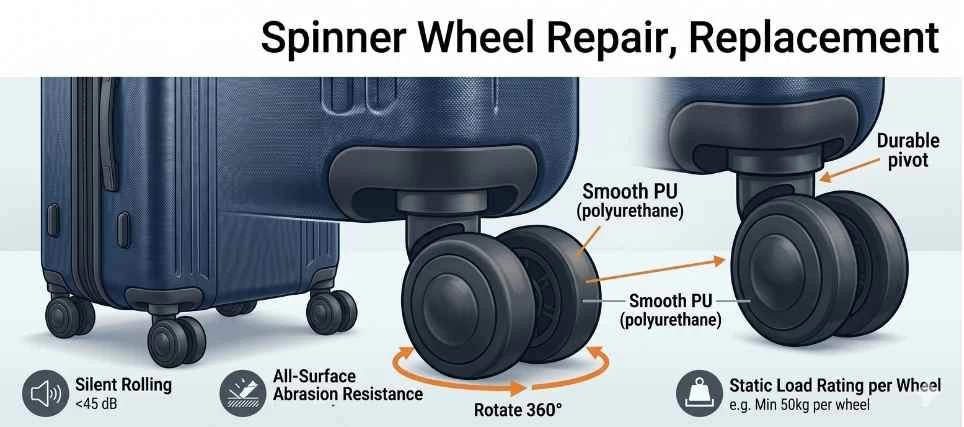
- Static load rating: minimum 50kg per wheel recommended for commercial luggage (200kg total for a 4-wheel set).
Criterion 3: Noise Performance — Silent Rolling as a Brand Signal
Airport concourses, hotel corridors, late-night hostel hallways — luggage wheel noise directly impacts traveler experience and brand perception. High-quality silent wheels should measure below 45 dB on hard-surface rolling tests. Request acoustic test data from suppliers during procurement evaluation.
Criterion 4: Abrasion Resistance — From Airport Floors to Cobblestone Streets
Real-world luggage wheel surfaces include: polished airport flooring, outdoor stone paving, cobblestones, gravel, and carpet. Insufficient abrasion resistance leads to rapid diameter reduction on uneven surfaces, destabilizing the case and creating uneven rolling. Specify abrasion resistance standards in your supplier RFQ.
Enjoy Caster Luggage Wheel Technology
Patented Two-Shot Injection Molding: Eliminating PU Delamination at the Source
Enjoy Caster applies the same core manufacturing technology to luggage wheels as to our office chair casters: patented two-shot injection molding (Two-Shot Injection Molding). The PU outer shell and plastic core are formed simultaneously in a single molding cycle, creating a molecular-level bond between materials. This completely eliminates the adhesive-layer failure that causes traditional luggage wheels to peel.
|
Manufacturing Technology Comparison |
|
Standard process: PU bonded to core in two steps → adhesive-dependent → delamination under sustained use |
|
Enjoy Caster: Patented single-cycle two-shot injection → molecular-level PU-core bond → no peeling, longer service life |
Four Core Performance Features
- Silent rolling: PU compound + precision steel bearings — low noise suitable for premium luggage brand positioning.
- True 360° spinner: Sealed steel ball bearing swivel base, low resistance, high rotational accuracy.
- All-surface abrasion resistance: Proprietary PU formulation tested on airport floors, cobblestones, carpet, and gravel.
- OEM / ODM customization: Logo embossing, size specification, color matching — full flexibility for luggage brand buyers.
Luggage Wheel Maintenance: 4 Habits That Extend Service Life
- Clean wheels after each trip: Wipe out sand and hair from wheel channels before storage to prevent bearing accumulation.
- Avoid dynamic overloading: Static load ratings don't account for impact loads. Keep dynamic loads below 80% of rated capacity.
- Inspect the spinner mount regularly: Check that swivel screws and clips are secure, especially for frequent international travelers.
- Store horizontally or wheels-up: Long-term vertical storage under static compression accelerates wheel deformation — horizontal or inverted storage preserves wheel shape.
Frequently Asked Questions (FAQ)
Q1: Can luggage wheels be self-replaced?
A: Some luggage brands design their wheels for tool-free replacement via snap-fit or screw-mount systems. Others use riveted mounts requiring professional repair. For B2B buyers, specifying user-replaceable wheel designs during procurement reduces after-sales service costs and improves brand loyalty.
Q2: PU vs TPR luggage wheels — which is more durable?
A: High-quality PU outperforms TPR in both abrasion resistance and noise reduction — but only when the PU-to-core bond is strong. Traditional two-step bonding creates delamination risk. Enjoy Caster's patented two-shot injection molding eliminates this failure mode, allowing PU to perform to its true material potential.
Q3: Is there an international standard for luggage wheel noise?
A: No unified international standard currently exists. However, premium luggage brands typically specify below 45–50 dB on hard-surface rolling tests. When evaluating suppliers, request rolling noise test data as an objective procurement benchmark.
Q4: 360° spinner wheels vs 2-wheel trolley — which is better for travel?
A: 360° four-spinner wheels are the current standard for travel luggage — enabling upright rolling without tilting, significantly reducing wrist and arm fatigue during airport transit. Two-wheel trolley designs offer better stability on rough terrain and are preferred for expedition or backpacker-style travel.
Q5: What are the most critical specs to confirm when sourcing luggage casters in bulk?
A: Prioritize these five: (1) wheel diameter and mounting hole specification, (2) static load rating per wheel, (3) PU bonding process (two-shot injection vs two-step adhesive), (4) bearing type (steel ball vs plastic), (5) OEM/ODM customization capability.
Q6: Do cobblestone streets cause the most wheel damage?
A: Yes — irregular surface impacts create repetitive shock loading that accelerates wheel wear far faster than smooth airport floors. Specifying high-abrasion PU compound and sealed bearings is the primary defense against cobblestone-related wheel failure.
Enjoy Caster: Your Luggage Caster OEM/ODM Manufacturing Partner
Enjoy Caster is a Taiwan-based specialist caster manufacturer supplying silent, durable, 360° spinner luggage wheels to global luggage brands, OEM factories, and commercial buyers. We offer full OEM/ODM customization capability — logo branding, size specification, color matching — with BIFMA-aligned quality standards.
- Luggage brands: High-spec, silent, non-peeling caster components that elevate product reviews and reduce warranty claims.
- ODM manufacturers: Stable supply with flexible specification and logo customization for private-label programs.
- E-commerce & retail: Consumer replacement wheel sets that build after-sales revenue and brand loyalty.
Contact us for samples, pricing, and OEM consultation: