
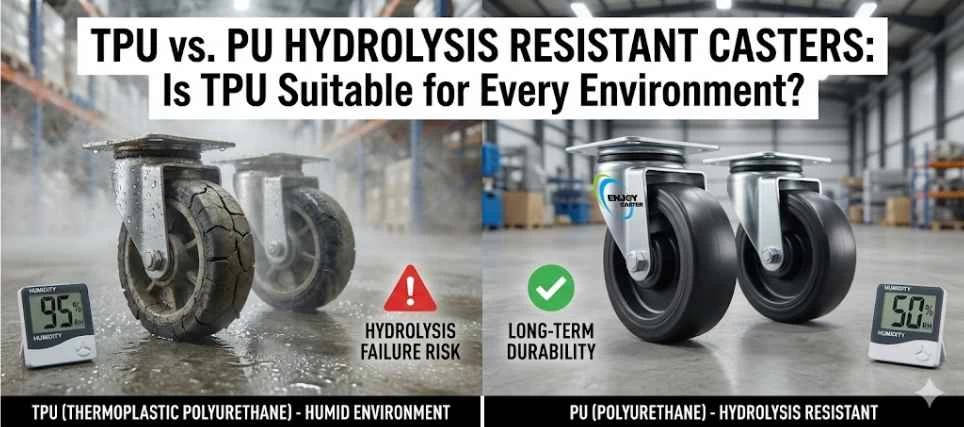
Is TPU Suitable for Every Environment?
Why TPU Wheels Fail More Easily in Humid Conditions
In discussions about caster materials,
TPU (Thermoplastic Polyurethane) is often considered a high-performance option—
especially in markets where environmental compliance is important.
However, in real-world applications, we frequently observe the opposite result:
TPU wheels tend to fail prematurely in humid or high-moisture environments.
This is not an isolated issue, but a direct consequence of material behavior.
1. Why TPU Is Vulnerable to Humidity
TPU contains chemical bonds that are sensitive to moisture.
When exposed to humidity, water vapor, or frequent cleaning over long periods,
TPU can undergo a well-known material degradation process called hydrolysis.
Typical signs of TPU hydrolysis include:
-
Surface softening or stickiness
-
Gradual powdering or cracking
-
Reduced bonding strength between tread and core
-
Eventual separation or structural failure
This degradation does not happen suddenly.
It accumulates over time—and once it starts, replacement is usually the only solution.
2. Why Humid Environments Accelerate Failure
The risk of TPU hydrolysis increases significantly in environments such as:
-
High-humidity regions
-
Air-conditioned spaces with frequent temperature changes
-
Offices or medical facilities with regular floor cleaning
-
Coastal or rainy climates
This explains why:
-
TPU wheels may perform well for years in dry, cold regions
-
Yet fail within a year in humid environments
The issue is not misuse, but material suitability.
3. Are PU Wheels Automatically Hydrolysis-Resistant?
A common assumption is that switching from TPU to PU solves the problem entirely.
In reality, PU wheels can still fail if the structural design is incorrect.
One of the most common failures in PU casters is hydrolysis-induced peel-off, where:
-
The PU tread itself remains intact
-
But separates from the nylon core
-
Rendering the caster unusable
This failure is not caused by PU alone,
But by how PU and nylon are bonded together.
4. How Enjoying Go Solves the Hydrolysis and Peel-Off Problem
This is where Enjoying Go’s core expertise lies.
Enjoying Go focuses exclusively on PU caster development and manufacturing,
to eliminate the most common PU failure: hydrolysis-related separation.
Our key solution is a patented one-time dual-material injection process:
-
One-time injection molding
PU and nylon are bonded in a single injection process
rather than glued, pressed, or over-molded in separate steps -
Structural material bonding
The bond is mechanical and chemical—not dependent on adhesives -
Designed for long-term and humid environments
Significantly reduces the risk of moisture-related separation
This approach addresses the problem at the structural level,
not just by changing material formulations.
5. A 5-Year Anti-Hydrolysis Guarantee
We are confident in the durability of our PU caster structure.
As a result, Enjoying Go offers an industry-leading commitment:
A 5-year guarantee that PU and nylon components will not separate due to hydrolysis.
This guarantee is based on:
-
Structural design
-
Controlled manufacturing processes
-
Long-term application experience
6. Durability Is Not Enough — User Experience Still Matters
Solving hydrolysis alone is not sufficient.
Caster performance must also support daily usability.
Enjoying Go PU casters feature:
-
Ultra-quiet, smooth dual-wheel design
-
Pre-lubricated construction for consistent rolling performance
-
Smooth movement across various floor surfaces
-
Reduced resistance that helps maintain workplace efficiency
Many customers report:
-
Easier movement
-
Lower noise levels
-
Longer service life
Conclusion: No Material Is Universal — Design Matters More
TPU is not a “bad” material,
But it is not suitable for every environment.
In humid or demanding applications,
The real deciding factors are:
-
Structural design
-
Manufacturing method
-
Consideration of long-term environmental exposure
Enjoying Go does not simply replace one material with another.
We solve hydrolysis risks at the structural and process level,
ensuring long-term reliability for PU casters in real working conditions.