
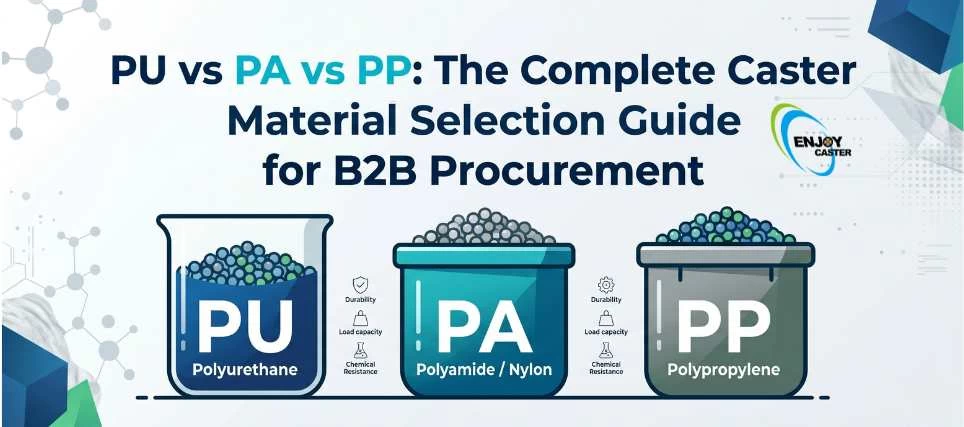
Premium PU, Strong PA, Cheap PP: Three Materials, Three Different Outcomes
Introduction: Why Procurement Professionals Must Understand Materials
In the caster wheel procurement process, more than 60% of customer complaints can be traced not to “manufacturing defects,” but to “the wrong material being chosen.” A PP caster mounted on an 80 kg office chair will crack within six months. A PA Nylon caster installed in a wood-floor office will scratch the floor within three months.
Choosing the wrong material is not a supplier issue, it is a risk planted at the procurement stage. This article provides a complete comparison of the three most common B2B caster material positions in today’s market: PU (Polyurethane, the premium-comfort choice), PA Nylon (Polyamide, the heavy-duty workhorse), and PP (Polypropylene, the cheap-but-fragile option), helping procurement professionals match the right material to the real application scenario.
1. The “Personality” of Each Material
If these three materials were people, their personalities would be unmistakable:
- PU (Polyurethane): the premium-comfort type. Quiet, floor-safe, wear-resistant, and elastic. The default choice for office and commercial environments.
- PA Nylon (Polyamide): the strong workhorse. High load capacity, heat-resistant, chemical-resistant. The hard-hitting choice for industrial carts and heavy-load environments.
- PP (Polypropylene): the cheap-but-fragile option. Lowest cost, lightest weight, but with low load capacity and weak impact resistance. Common only in disposable or extremely light-duty applications.
Now look at the fundamental chemical and physical differences:
|
Property |
PU (Premium) |
PA Nylon (Strong) |
PP (Cheap) |
|
Positioning |
Comfortable, quiet, durable |
Strong, heavy-load, heat-resistant |
Cheap, light, fragile |
|
Hardness Range |
Shore A 80–95 (elastic) |
Shore D 80–85 (very hard) |
Shore D 70–75 (hard but brittle) |
|
Wear Resistance |
Excellent |
Good (but damages floors) |
Poor (wears smooth quickly) |
|
Impact Resistance |
Excellent (PU has toughness) |
Excellent (PA structural strength) |
Poor (brittle at low temperatures) |
|
Noise Performance |
Excellent |
Poor (audible rolling noise) |
Mediocre to poor |
|
Floor Friendliness |
High, safe for wood and tile |
Low, scratches floors |
Moderate, leaves scuff marks |
|
Load Capacity |
Medium to high (50–120 kg per caster) |
Very high (up to 300+ kg per caster) |
Low (under 30 kg per caster) |
|
High-Temp Resistance |
Stable below 85°C |
Stable above 120°C |
Softens above 70°C |
|
Chemical Resistance |
Moderate |
Excellent |
Poor (cracks on oil contact) |
|
Relative Cost |
Mid to mid-high |
Mid |
Lowest (1/3 to 1/2 of PU) |
|
Typical Lifespan |
3–7 years |
5–10 years (industrial heavy-duty) |
6 months to 2 years |
|
Biggest Drawback |
Higher cost than PP |
Damages floors, loud rolling noise |
Low load, low-temp brittleness, short life |
The key insight here: behind every price gap is a lifespan gap. PP may look 50–60% cheaper on paper, but if applied to the wrong scenario, full replacement may be required within a year, pushing Total Cost of Ownership (TCO) well above PU.
2. Reverse-Engineering Material Choice from the Application
Rather than reasoning forward from material to application, experienced buyers reverse it, starting from application and reasoning back to material:
|
Application Scenario |
Recommended Material |
Reasoning |
|
PU (Shore A 85) |
Quiet, floor-safe, long-term durability |
|
|
General office chairs |
PU or PA + PU rim composite |
Balance of comfort and cost |
|
Hospital beds / medical carts |
PU (disinfectant-resistant formula) |
Quiet, shock-absorbing, chemical-resistant |
|
Heavy industrial carts (>150 kg) |
PA Nylon or PA + PU rim composite |
High structural strength, heat resistance |
|
Warehouse / logistics pallet trucks |
PA Nylon |
Wear-resistant, low cost, ideal on smooth concrete |
|
Display racks / light retail fixtures |
PP |
Low cost, acceptable for light, short-term use |
|
DIY tool chests / disposable household items |
PP |
Entry-level applications with extreme budget sensitivity |
|
PU (soft, Shore A 80) |
Maximum floor protection, prioritizes silence |
|
|
Education / library reading seating |
PU |
Balanced cost and noise control |
|
Food / pharmaceutical cleanrooms |
PU (food-grade certified) |
Resists chemical cleaners, no VOC emissions |
This reference table belongs in the procurement workflow of every office planner, facility manager, and corporate buyer. Print it and place it inside the RFQ kit as an internal alignment tool before requesting quotations from any supplier.
3. The Three Most Common (and Costly) Material Selection Mistakes
From Enjoy Caster’s years of serving European, North American, and Japanese B2B customers, three material-selection mistakes appear repeatedly, and they are the most expensive ones:
Mistake 1: Looking only at unit price, ignoring Total Cost of Ownership (TCO)
This is the most common reason buyers wrongly select PP. The upfront saving of 50% looks attractive on paper. But once “replacement frequency + reinstallation labor + employee complaints + chair scrap risk” is included, PP’s actual TCO can run 2–3 times higher than PU.
Correct mindset: during RFQ, ask the supplier for expected lifespan, warranty period, and replacement policy, and compare suppliers on annualized cost, not per-unit cost.
Mistake 2: Believing “harder = more durable”
This is the second-most common misconception. PA Nylon is indeed harder than PU, but “hard” does not equal “durable.” In an office environment, PA Nylon casters damage floors, generate noise, and transmit impact back into the chair frame and the user, accelerating wear on both the chair structure and the floor.
Correct mindset: match hardness to floor type and load requirement, not chase the maximum value. Office wood floors call for PU; industrial concrete calls for PA.
Mistake 3: Ignoring chemical exposure and temperature conditions
Medical, food, and laboratory environments routinely contact alcohol, bleach, and detergents. PP exposed to these chemicals repeatedly will age fast and crack. PP also does not handle heat well: warehouse summer temperatures alone can soften and deform it. Yet at the procurement stage, when buyers focus only on hardness and load rating, no one raises this risk.
Correct mindset: during RFQ, proactively disclose the daily cleaning agents in use and the ambient temperature range, then ask the supplier to recommend the matching material formulation.
4. Where PP Casters Actually Belong
Some buyers ask: “If PP has so many drawbacks, why is it still so common in the market?” Fair question. PP is not unusable. It is only valid when applied to the right scenario:
- Ultra-light load, ultra-short term: retail display fixtures, temporary event carts, household DIY tool chests.
- Extreme entry-level products with hyper-sensitive budgets: the lowest tier of value furniture brands.
- Environments where floor protection is irrelevant: warehouse corners, outdoor temporary storage areas.
For office chairs, medical equipment, industrial carts, and commercial furniture, scenarios involving daily load, repeated use, and long-term investment, PP is almost always the wrong choice. The shared view among experienced buyers is straightforward: if the application will last more than two years, PP should not even enter the shortlist.
5. Enjoy Caster’s Composite Solution: When a Single Material Is Not Enough
Through extensive engagement with European, North American, and Asian customers, Enjoying Go Co., Ltd. (Enjoy Caster) has observed a consistent pattern: many customers simultaneously need the structural strength of PA Nylon and the quietness and floor friendliness of PU. The traditional approach, gluing a PU ring onto a PA Nylon core, eventually delaminates after extended use.
Enjoy Caster’s answer is a patented PA Nylon + PU Rim integrated injection technology: during manufacturing, the PA Nylon core and the PU outer rim bond at the molecular level, completely eliminating the adhesive interface and achieving structural anti-delamination.
This technology is certified by BIFMA, SGS, RoHS, and REACH, and supports PCR recycled material formulations, satisfying both European sustainability thresholds and Japanese quality expectations. In other words, this is not simply “two materials combined.” It is a redefinition of what is structurally possible in caster material design.
|
Technical Aspect |
Traditional PU Ring Bonding |
Enjoy Caster Integrated Injection |
|
Bonding Method |
Secondary adhesion via glue layer |
Molecular-level thermal fusion, no adhesive |
|
Delamination Risk |
Prone to failure under heat or long-term use |
Structurally anti-delamination |
|
Load Performance |
Limited by adhesive strength |
Load transferred directly to PA Nylon core |
|
Noise & Floor Protection |
Provided by PU rim |
Provided by PU rim |
|
Production Consistency |
Subject to manual bonding precision |
Stable injection process, batch-consistent |
Conclusion: Selecting Material Is Really Selecting Fit-to-Scenario
There is no absolute winner between PU, PA, and PP. There is only the question of “which is the right fit.” To summarize their essential positioning in one line each:
- PU is a long-term investment for office and commercial environments.
- PA is the hard-working backbone of industrial heavy-load applications.
- PP is a short-term, ultra-light solution and should never appear on long-life equipment.
Senior B2B procurement professionals always return to the same principle: first ask “where will this caster operate, who uses it, what load will it carry, and how long is it expected to last,” and only then talk about material.
As a Taiwan-based PU caster manufacturer, Enjoy Caster offers a complete product line from pure PU to composite PA Nylon + PU Rim integrated injection, along with samples and technical consultation tailored to each application. If you are finalizing material specifications for your next round of OEM caster procurement, contact us, and let manufacturing-side expertise help you choose the right material and direct every dollar where it matters most.