
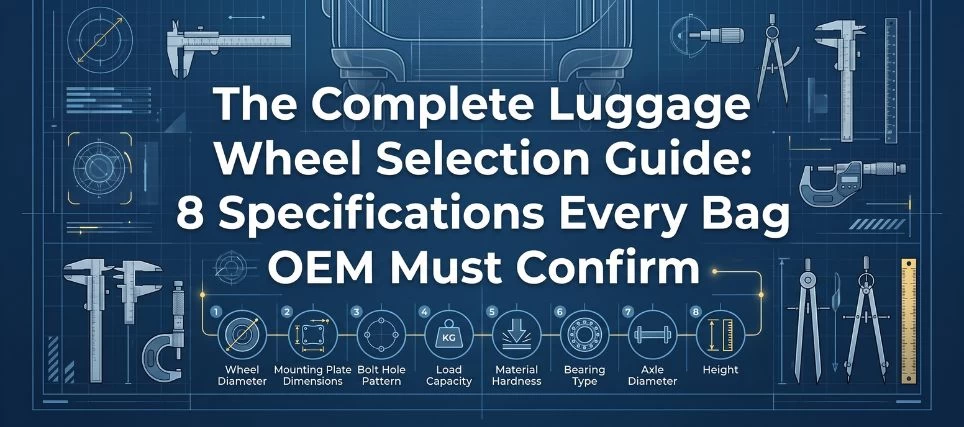
The Complete Luggage Wheel Selection Guide: 8 Specifications Every Bag OEM Must Confirm
|
Summary: A luggage wheel RFQ usually has three fields — diameter, housing type, and colour. What actually determines your return rate is five other things: tread hardness matched to real-world surfaces, bearing grade, the basis of load calculation, how noise performance is verified, and the process joining tread to core. Here are all eight specifications we recommend writing into your specification. |
Why Luggage Wheels Are Consistently Underestimated H2
Across a product's life, luggage wheels endure conditions more extreme than most people assume.
On a single international trip, one set of wheels experiences high-speed dragging across airport terrazzo and polished stone, drop impacts on conveyor belts and baggage carousels, sub-zero temperatures in the cargo hold, heat and humidity on arrival, and rough stacking by handlers. All of it happens within a few hours — and repeats every trip.
The result is a very high concentration of complaints. Problems with shells, handles and zips are spread across categories, but wheels are frequently the single largest cause of returns. And wheel failure is a particularly bad experience: it is not "slightly inconvenient" — it removes the product's core function and forces the traveller to drag the case for the rest of the journey.
Which is why we think wheel specifications deserve more detail than they usually get.
Specification One: Diameter — Confirm the Structural Space First H2
Larger diameters clear thresholds, tile joints and kerbs better, with lower rolling resistance. But luggage wheel diameter is constrained by two things: the structural space in the case base, and airline limits on external baggage dimensions, since wheel height counts toward total height.
The practical trade-off is to select the largest diameter that does not push the case into the next size bracket. This matters especially on 20-inch cabin lines, where a larger wheel can take the case over carry-on limits — a condition design has to lock down first.
Information to supply at RFQ: available height in the case base, target external size bracket, and the usable area of the housing mounting face.
Specification Two: Tread Material and Hardness — Selected Backwards From the Surface H2
Luggage meets far more varied surfaces than office furniture: polished airport stone, rough station concrete, hotel carpet, paving and asphalt. No single surface can serve as the basis for selection.
The underlying principle is the same as for any rolling element — harder surfaces take softer treads, softer surfaces take harder treads. What makes luggage distinctive is that it must handle both, so the practical approach is a compromise hardness compensated by a larger diameter.
|
Usage Profile |
Dominant Surface |
Selection Direction |
|
Short-haul business (airport-centric) |
Polished stone, terrazzo |
Softer tread, prioritising quietness and smooth rolling |
|
Long-haul leisure (mixed surfaces) |
Stone, paving and carpet |
Compromise hardness plus larger diameter |
|
Urban commuting/student |
Asphalt, paving, stairs |
Harder abrasion-resistant tread with reinforced impact tolerance |
|
Premium brand lines |
Airports and hotels |
Softer tread with upgraded bearings, feel and quietness first |
Hardness is only the starting point — what really determines perceived quality is how hardness pairs with the bearing, which the noise section develops further. (Related reading: The Engineering Behind Silent Luggage Wheels)
Specification Three: Bearing Grade — The Field Most Often Omitted H2
Bearings govern three things: rolling resistance (how much effort pushing takes), running noise, and how smoothness degrades over time.
Luggage wheels typically use either ball bearings or plain bushings, and grade differences are usually absent from catalogues entirely. The practical difference is stark: a low-grade configuration may feel fine at the factory, but after dozens of trips through dust, moisture and impact, rolling resistance rises noticeably. This is the main reason a case becomes "hard to push after a while".
Ask directly at RFQ for bearing type and grade, whether dust sealing is fitted, and durability test evidence under dusty conditions. Suppliers rarely volunteer this field.
Specification Four: Housing Interface and Mounting Tolerance H2
How the wheel housing attaches to the shell determines the load path for the whole assembly. Riveting, screw fixing and snap-fit are all common, each with trade-offs.
But the real risk lies in tolerance rather than type. Small deviations in hole spacing, screw specification or base plate thickness can produce assemblies that are too tight — concentrating stress and cracking the shell — or too loose, working free over time until the housing detaches.
Recommended practice: supply the housing mounting drawing at RFQ stage and require written tolerance confirmation. When switching supplier, always validate with physically installed samples rather than assuming interchangeability from a datasheet.
Specification Five: Load Calculation — Do Not Count Only the Case H2
Two aspects of luggage wheel load assessment are consistently underestimated.
First, dynamic impact. Baggage is dropped onto carousels and conveyors, generating momentary loads several times the static figure. Second, uneven distribution. When a case is towed at an angle, usually only two wheels are on the ground — so each carries half the total weight, not a quarter.
The conservative approach is therefore: take case net weight plus the airline checked baggage limit as the total, size on two-wheel loading, then add a safety factor appropriate to the product tier. State your target market's checked baggage limits at RFQ, since they vary meaningfully between carriers and cabin classes.
Specification Six: Noise — Write It as a Verifiable Condition H2
Quietness is among the most immediately perceived qualities in luggage and one of the most frequently mentioned in reviews. But "silent design" is a meaningless phrase in a specification.
The meaningful version specifies conditions: noise performance on a named surface material at a named towing speed, with the supplier required to state measurement method and test environment. It also helps to understand that noise has more than one source — tread hardness versus surface, bearing precision, and resonance in the housing itself — and the remedies differ entirely.
(Related reading: The Engineering Behind Silent Luggage Wheels — Why Some Suitcases Are So Loud in Airports)
Specification Seven: Abrasion and Weathering Resistance H2
Abrasion resistance determines how much distance the tread survives; weathering resistance determines how stable the material stays under UV, heat, humidity and cold.
What makes luggage distinctive is the extreme temperature range. Cargo hold cruise temperatures can fall below freezing, while arrival on an apron or outdoors can mean an immediate return to high heat. Polymers stiffen and embrittle when cold and soften when hot, and repeated cycling accelerates ageing.
Request abrasion test basis, weathering data covering UV and humid heat, and an explanation of hardness change at low temperature. Current product line ranges are [product specification ranges TBC].
Specification Eight: The Tread-to-Core Bonding Process — The Only One You Cannot Fix Later H2
Get any of the first seven wrong, and you can usually improve things by adjusting the specification. Not the eighth.
Most PU luggage wheels are made by two-step bonding: the core is moulded first, then the PU tread is attached with adhesive or mechanical keying, leaving a bond interface barely visible. That interface is the origin of every "blowout" case — when lateral shear from towing concentrates at the tread edge, or thermal cycling makes the two materials contract and expand by different amounts, the adhesive layer peels from the edge inward until the tread separates.
Enjoying Go Co., Ltd. (Enjoy Caster) uses a patented One-Time Injection process, moulding PU directly over the core within a single process to form one integrated body — no discrete bond interface, and therefore no peel initiation point.
Verification is refreshingly simple: request a longitudinally sectioned sample. A clear separation line at the cut face means two-step bonding; no visible interface means an integrated structure. Ten seconds, no test equipment required.
(Related reading: Why Luggage Wheels Blow Out — Understanding PU Tread Delamination)
RFQ Template: Ask Everything in One Email H2
|
Information to Provide |
Example Entry |
|
Product positioning |
20" cabin / 28" checked / business line |
|
Available space in case base |
Height XX mm, housing mounting face XX × XX mm |
|
Target load |
Case net weight XX kg plus 23 kg checked limit; please size on two-wheel loading |
|
Dominant surfaces |
Primarily polished airport stone, also paving |
|
Noise requirement |
Please supply noise measurement data and method on stone at XX speed |
|
Housing interface |
Drawing attached; currently riveted |
|
Colour requirement |
Standard black/brand custom colour (Pantone reference attached) |
|
Documents required |
RoHS, REACH, abrasion and weathering test reports |
|
Bonding process |
Please state at which stage PU and core are joined, and supply a sectioned sample |
Frequently Asked Questions H2
Q1: How should luggage wheel load be calculated safely? H3
Take case net weight plus your target market's airline checked baggage limit as the total, and size per wheel on two-wheel loading — because a case towed at an angle usually has only two wheels on the ground. Add a safety factor for the product tier and tell your supplier whether carousel drop impact must be withstood.
Q2: Is a larger wheel diameter always better? H3
In performance terms, yes — better obstacle clearance and lower rolling resistance. But it is limited by structural space in the case base and airline external dimension limits, since wheel height counts toward total height and can push a cabin case out of its size bracket. Select the largest diameter that keeps you inside the bracket.
Q3: Why do some suitcases become hard to push after a while? H3
Most often, the bearing. Low-grade configurations feel fine when new, but after exposure to dust, moisture, and impact, rolling resistance rises noticeably. Ask specifically for bearing type and grade, dust sealing, and durability evidence under dusty conditions.
Q4: If the datasheet matches, can I swap suppliers directly? H3
Do not assume so. Identically stated specifications can differ in actual bearing grade, measured tread hardness, and housing mounting tolerance. Always validate with physically installed samples, especially hole spacing and screw specification.
Q5: How can I judge blowout risk before purchasing? H3
Request a longitudinally sectioned sample. A clear separation line means a bond interface exists and peeling is possible; no visible interface means an integrated structure. Ten seconds, no equipment — the highest-return verification available.
Conclusion & Next Step H3
The more specific your luggage wheel specification, the fewer returns after production. Five of these eight items have no field at all in most catalogues — you have to ask.
And the most decisive of them, the eighth, needs only one sectioned sample to judge.
- Request a sectioned sample: ten seconds to confirm whether a bond line exists — the fastest blowout risk assessment available.
- Request test samples: send your case specification, target load, and dominant surfaces, and we will match specifications for installed validation.
- Request product line data and warranty terms: specification ranges and warranty conditions for the luggage wheel line are [warranty terms TBC] — contact us for the full statement.
Enjoy Caster | Enjoying Go Co., Ltd. | www.enjoycaster.com | Patented One-Time Injection technology
About the Author H3
Rita Lai | Sales Manager, Enjoying Go Co., Ltd. (Enjoy Caster). She leads international B2B business development for caster products, working with office furniture, medical equipment, logistics, and industrial equipment manufacturers, and handles front-line technical discussions at international trade fairs including ORGATEC, MEDICA, and the Taiwan Int'l Tools & Hardware Expo. The failure diagnosis methods and procurement guidance in this article are drawn from actual client projects.
About Enjoy Caster: Enjoying Go Co., Ltd. is a Taiwanese caster manufacturer whose core technology is the patented One-Time Injection process, which resolves PU caster delamination at the manufacturing level. Products meet BIFMA standard requirements and hold SGS, RoHS, REACH, and PCR certifications. The full range, including custom colours, carries a 5-year warranty. www.enjoycaster.com