
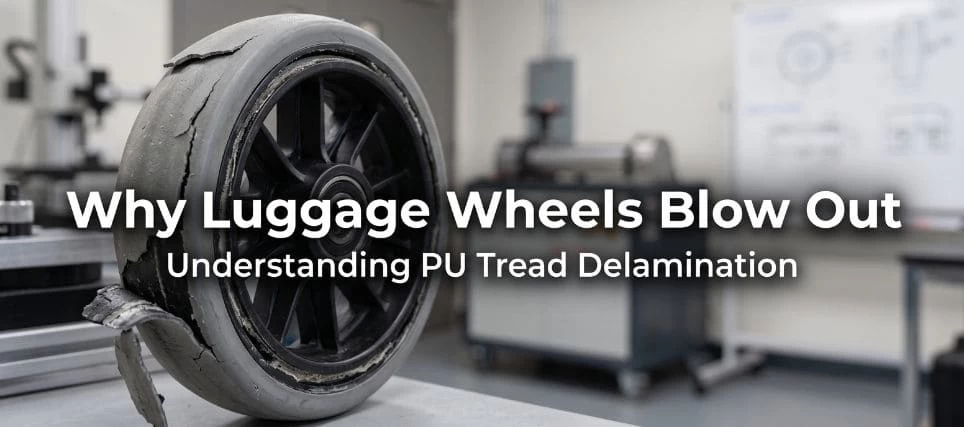
Why Luggage Wheels Blow Out: Understanding PU Tread Delamination
|
Summary: What users call a blowout is usually not wear — it is the PU tread separating from the core in one piece. The cause is the manufacturing process, not the material: two-step bonding leaves an adhesive interface between core and tread, and three conditions specific to luggage all attack that interface — lateral shear from towing, thermal cycling between cargo hold and ground, and conveyor drop impact. Diagnosing it takes one sectioned sample. |
First, Separate Wear From Separation H2
Luggage wheel failures fall into two categories that look similar and have entirely different causes.
|
Characteristic |
Abrasion Failure |
Interfacial Separation ("Blowout") |
|
Appearance |
Tread thins uniformly with surface friction marks |
Tread lifts at the edge or detaches from the core entirely |
|
Onset |
Gradual, proportional to distance travelled |
Can occur suddenly, weakly related to distance |
|
Sectioned face |
PU layer intact, simply thinner |
A separation plane visible between PU and core |
|
Root cause |
Material abrasion grade or specification choice |
Process — the structural weakness of the bond line |
|
Fixable by changing material? |
Yes (higher abrasion grade or adjusted hardness) |
No (a tougher PU does not change interfacial bond strength) |
|
Effect on the user |
Gradually harder to push, noisier |
The case loses its function entirely and must be dragged |
The practical use of this table: when a returned sample arrives, section it and look at the face before deciding what to change. We have seen too many cases where a buyer spent two years requesting more abrasion-resistant PU while every failed sample showed interfacial separation — the material change was entirely irrelevant, because the material was never the problem.
The Bond Line: Common Origin of Every Blowout H2
The overwhelming majority of PU luggage wheels are made by two-step bonding.
The core — typically PP, ABS or nylon — is injection moulded first, and the PU tread is then applied over it with adhesive or mechanical keying. Between them sits an interface that is barely visible but structurally quite distinct.
That interface is intact when the wheel leaves the factory. The problem is that it is the weakest layer in the assembly — the core is strong and the PU is tough, but the adhesive holding them together is far weaker than either parent material. When external forces accumulate, failure always begins at the weakest point.
And luggage happens to impose three conditions that all attack it.
Trigger One: Lateral Shear From Towing H2
The biggest difference between luggage and an office chair is that luggage is almost never pushed straight.
When a user tows at an angle by the handle, the wheels carry not only vertical weight but a sustained lateral component. That lateral force generates shear stress along the contact plane between tread and core — and the shear concentrates precisely at the tread edge, which is the exposed end of the bond line.
Frequency matters more still. Every turn, swerve, gradient and threshold in a journey is another shear cycle. Individually none is close to destructive, but they accumulate until the adhesive develops its first micro-crack.
Once the edge cracks, damage accelerates — the opening lets subsequent shear wedge in more easily, and separation propagates inward. This is why blowouts feel sudden: hundreds of trips of accumulation are invisible until the final rapid collapse.
Trigger Two: Thermal Cycling Between Cargo Hold and Ground H2
This condition is specific to luggage and absent from most wheel applications.
On an international flight, baggage can experience considerably low temperatures in the hold, then return immediately to ambient or high heat on the apron, the conveyor or outdoors. One trip is one complete thermal cycle, and a suitcase may go through dozens or hundreds across its life.
The issue is material behaviour: PU treads and cores (PP, ABS or nylon) have different coefficients of thermal expansion. As temperature changes, the two contract and expand by different amounts, generating stress at their contact plane — and in a two-step bonded structure, the layer carrying that stress is the adhesive.
Thermal cycling damages differently from shear: not one large force but repeated small tugs. The adhesive accumulates micro-cracks and fatigue until, during some later tow, shear tears it open in one go. It also explains a familiar observation — cases that fly frequently fail sooner than city-use cases, even at comparable towing distances.
(The same thermal cycling mechanism appears in cold chain logistics equipment — related reading: Winter Warehousing & Logistics: Caster Material Selection for Low-Temperature Environments)
Trigger Three: Drop Impact From Conveyors and Carousels H2
The third condition is instantaneous.
Checked baggage is dropped repeatedly: from conveyor to cart, from cart into the hold, from the hold onto the carousel. On each landing the wheels may be the first point of contact, absorbing momentary loads far above the static rating.
What makes impact damaging to a bond line is its direction: it pulls perpendicular to the interface. Shear slides along the plane, but impact pulls the two layers apart — a far less favourable loading direction for an adhesive joint.
Impact also frequently occurs just after cold exposure, as baggage comes off the aircraft, when the PU is still stiff and least able to absorb energy. All three conditions coinciding at that moment makes it the most likely point of critical damage.
The Solution Is at Process Level, Not Material Level H2
Once the three mechanisms are understood, the conclusion is direct: as long as the bond line exists, these conditions will keep attacking it. Raising PU abrasion grade extends the tread's own life and does nothing for interfacial strength.
Enjoying Go Co., Ltd. (Enjoy Caster) uses a patented One-Time Injection process: PU is moulded directly over the core in a single process, so the two form one integrated body at the moulding stage. There is no discrete adhesive layer, and therefore no interface that can separate.
|
Loading Condition |
Two-Step Bonded Structure |
One-Time Injection Structure |
|
Lateral shear from towing |
Shear concentrates at the exposed bond line edge, peeling inward over time |
Carried by the body structure, not by adhesive strength |
|
Thermal cycling |
Differential expansion continuously stresses the adhesive, causing fatigue cracking |
One integrated body; interfacial stress substantially reduced |
|
Drop impact |
Pulls perpendicular to the interface — the worst direction for an adhesive joint |
No discrete interface, so no such weakness |
|
Failure mode |
Tread separates in one piece; the case loses its function |
No interfacial separation path exists |
|
Verification |
Clear separation line visible at the cut face |
No interface visible at the cut face |
The Ten-Second Verification H2
Everything above can be verified with a single action: section the wheel lengthwise and look at the face.
- A clear separation line is visible → a bond interface exists, the wheel is two-step bonded, and peeling risk is present.
- No visible interface, no discernible boundary between PU and core → an integrated structure with no peel initiation point.
The check requires no test equipment and no waiting period. We recommend that every bag OEM request longitudinally sectioned samples at RFQ stage — it is the single highest-return action in the whole evaluation process.
A second practical indicator is warranty terms. A supplier willing to offer longer wheel coverage has generally addressed this risk at process level, because warranty underwrites process commercially. Warranty conditions for the Enjoy Caster luggage wheel line are [warranty terms TBC] — contact us for the full statement.
Frequently Asked Questions H2
Q1: What exactly is a luggage wheel "blowout"? H3
What users call a blowout is usually interfacial separation — the PU tread detaching from the core in one piece rather than wearing thin. The two look similar but have entirely different causes: wear is a material or specification issue, separation is a process issue.
Q2: Will a more abrasion-resistant PU prevent blowouts? H3
No. A higher abrasion grade extends the tread's own life and does not change the bond strength between tread and core. As long as the interface exists, accumulated towing shear, thermal cycling and drop impact will still cause separation.
Q3: Why do frequently flown suitcases fail sooner? H3
Thermal cycling. On an international flight, baggage experiences low temperatures in the hold then returns to ambient or high heat on arrival — one complete thermal cycle. PU and core have different coefficients of thermal expansion, so repeated cycling fatigues their contact plane. Even at similar towing distances, frequently flown cases accumulate far more cycles than city-use cases.
Q4: How do I tell whether a returned sample wore out or separated? H3
Section the wheel lengthwise and examine the face. Uniform thinning with surface friction marks is abrasion; a visible separation plane between tread and core with edge lifting is interfacial separation. Misreading it sends the remedy in completely the wrong direction.
Q5: How can procurement assess blowout risk before ordering? H3
Request a longitudinally sectioned sample. A clear separation line means a two-step bonded structure with peeling risk; no visible interface means an integrated structure. Ten seconds, no equipment — the highest-return action in the evaluation process.
Conclusion & Next Step H3
What makes a blowout so damaging to a brand is that it is an all-or-nothing failure. A sticking zip is still usable; a detached wheel turns luggage into a burden — and it usually happens when the traveller is least able to deal with it: mid-transfer, in a hotel corridor, at the airport on the way home.
Which is why we believe this specification is worth settling at RFQ stage. It needs no elaborate testing — only one sectioned sample.
- Request a sectioned sample: ten seconds to confirm whether a bond line exists — the fastest blowout risk assessment available.
- Bring us your failed samples: we will help determine whether the cause is abrasion or interfacial separation. Even if you source elsewhere, that diagnosis guides your remedy correctly.
- Request test samples: send your case specification, target market, and checked baggage conditions, and we will match specifications for installed validation.
Enjoy Caster | Enjoying Go Co., Ltd. | www.enjoycaster.com | Patented One-Time Injection technology
About the Author H3
Rita Lai | Sales Manager, Enjoying Go Co., Ltd. (Enjoy Caster). She leads international B2B business development for caster products, working with office furniture, medical equipment, logistics, and industrial equipment manufacturers, and handles front-line technical discussions at international trade fairs including ORGATEC, MEDICA, and the Taiwan Int'l Tools & Hardware Expo. The failure diagnosis methods and procurement guidance in this article are drawn from actual client projects.
About Enjoy Caster: Enjoying Go Co., Ltd. is a Taiwanese caster manufacturer whose core technology is the patented One-Time Injection process, which resolves PU caster delamination at the manufacturing level. Products meet BIFMA standard requirements and hold SGS, RoHS, REACH, and PCR certifications. The full range, including custom colours, carries a 5-year warranty. www.enjoycaster.com