
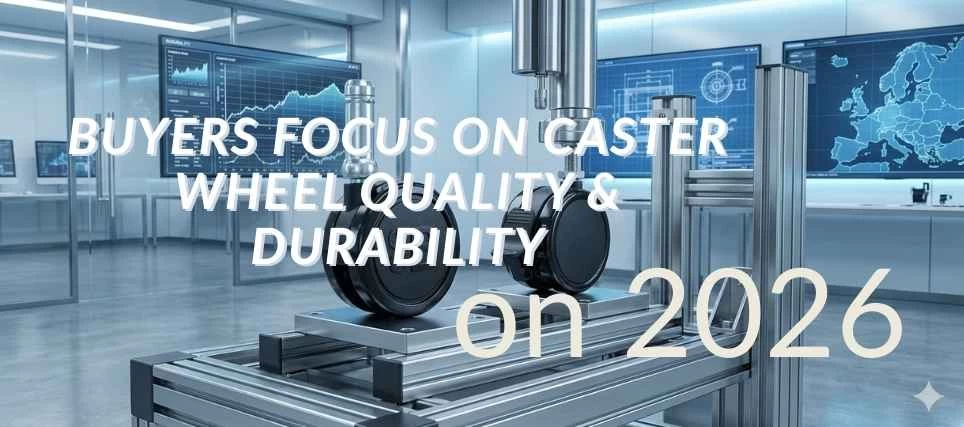
Why European Buyers Are Focusing on Caster Wheel Quality and Durability in 2026
How Regulations, Cost Pressure, and Long-Term Performance Are Redefining Caster Selection
In the European market, caster wheels have never been a minor component.
By 2026, they will become an even more critical factor influencing product safety, lifecycle cost, and brand reputation.
Across recent exhibitions, sourcing discussions, and RFQs, European buyers are asking the same questions repeatedly:
How long will the caster last?
Has it been properly tested?
Can performance remain stable over time?
This growing focus on quality and durability reflects bigger changes in how European buyers evaluate suppliers.
1. Rising Costs Make Durability a Strategic Decision
European manufacturers and brand owners are facing increasing pressure from:
-
Higher labor and material costs
-
Expensive after-sales service and replacement
-
Greater emphasis on total cost of ownership (TCO)
Under these conditions, a caster that fails prematurely can quickly become a costly liability.
As a result, buyers are more willing to invest in higher-quality caster wheels that reduce long-term risk, even if the initial unit price is higher.
2. Testing Standards and Regulations Are No Longer Optional
In 2026, compliance with testing standards is no longer a differentiator — it is a baseline requirement.
European buyers frequently ask about:
-
Durability testing under repeated rolling cycles
-
Load capacity performance over time
-
Compliance with furniture and equipment safety standards
In applications such as office furniture, medical equipment, and public facilities, caster failure can lead to safety issues, warranty claims, and reputational damage — far exceeding the cost of the component itself.
3. Real-World Lifespan Matters More Than Catalog Specifications
European buyers are increasingly skeptical of specifications listed on datasheets alone.
Instead, they want to understand:
-
How the caster performs after years of real-world use
-
Whether the wheel material hardens, cracks, or delaminates over time
-
How smoothly and quietly the caster rolls across different floor surfaces
Suppliers who can clearly explain material behavior, manufacturing processes, and long-term test results are far more likely to gain trust.
4. Quality Issues Often Come from What Buyers Cannot See
Many European buyers become highly sensitive to caster quality only after encountering problems.
In many cases, failures are caused by factors that are not visible from the outside, such as:
-
The bonding method between the PU tread and the wheel core
-
Material consistency across production batches
-
Whether the design is optimized for long-term use rather than short-term testing
This is why structural integrity and process stability are increasingly important evaluation criteria in Europe.
5. European Buyers Are Looking for Long-Term, Reliable Partners
In 2026, European buyers are no longer comparing suppliers based solely on price or appearance.
Instead, they assess whether a supplier:
-
Understands European quality expectations and compliance requirements
-
Has stable production capacity and quality control systems
-
Can provide technical input early in the product development process
This shift favors manufacturers with proven experience, transparent processes, and a long-term mindset.
Conclusion: Caster Quality Is the Foundation of Trust in the European Market
In Europe, caster wheels are not a small detail — they are a critical component that directly impacts safety, cost, and brand credibility.
As expectations rise in 2026, choosing the right caster supplier becomes a strategic investment rather than a simple purchasing decision.