
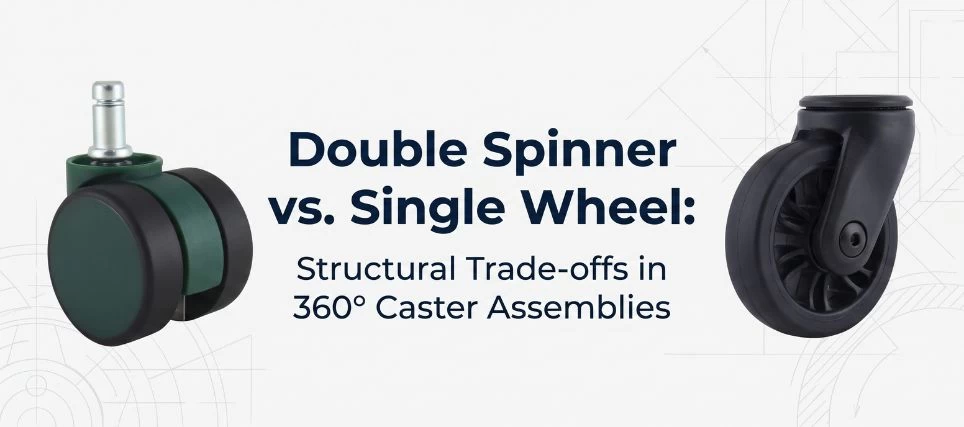
Double Spinner vs. Single Wheel: Structural Trade-offs in 360° Caster Assemblies
H1
|
Summary: A double spinner is not superior on every axis. It genuinely wins on load distribution, straight-line stability and failure redundancy — but single wheels hold their own on manoeuvrability, structural simplicity, serviceability and cost. The choice should be driven backwards from product positioning and real usage in your target market, not from an assumption that double spinners are inherently premium. |
Defining Terms: What a Double Spinner Actually Is H2
Luggage 360° spinners divide into two configurations by wheel count.
A single-wheel configuration mounts one wheel per housing, four housings and four wheels in total — commonly a "four-wheel case". A double configuration mounts two wheels side by side in each housing, four housings and eight wheels in total — the "eight-wheel case" of retail marketing.
Worth noting: an eight-wheel case still has four swivel assemblies, each carrying two wheels. That distinction matters, because it determines how load is distributed and where the real differences lie.
Axis One: Load Distribution and Rolling Resistance H2
This is where the double configuration holds its most substantial advantage.
The same load is shared between two wheels, so contact pressure per wheel is roughly halved. Lower contact pressure brings three consequences: less tread deformation and therefore lower rolling resistance, reduced tendency to develop permanent flat spots during long static storage, and slower tread wear.
Two wheels side by side also form a wider contact base, improving straight-line stability on hard surfaces — which is why many users describe eight-wheel cases as feeling steadier and less prone to wander.
There is a precondition: both wheels must genuinely contact the ground. If housing rigidity is insufficient or the surface is uneven, one wheel can carry the load alone — at which point the advantage disappears and the narrower single wheel actually sees higher pressure.
Axis Two: Manoeuvrability and Towing Feel H2
This conclusion may run against intuition: single wheels are usually more agile.
The reason is geometry. Two wheels mounted side by side travel different radii through a turn, so the inner and outer wheel must rotate at different speeds. Where they cannot differentiate freely, turning generates additional friction. Single wheels have no such constraint, so spinning on the spot and tight-radius turns typically feel lighter.
The practical difference shows up by scenario: pushing straight down an airport concourse, the double configuration's stability advantage is clear; but in a crowded boarding queue, inside a lift or in a hotel room where direction is adjusted constantly in small increments, single wheels often feel more responsive.
Axis Three: Impact Tolerance and Failure Mode H2
This axis needs to be read on two levels.
In redundancy terms, double configurations are more resilient: if one wheel is damaged, the other can still support the case so it does not immediately lose function. A single wheel fails completely the moment it breaks.
In per-wheel strength terms, each wheel in a double configuration is narrower and structurally weaker against lateral impact — hitting a threshold or kerb — than a wider single wheel. So double configurations are less likely to fail completely, but more likely to suffer partial damage.
Whichever configuration is chosen, the most critical failure mode is identical: the PU tread separating from the core. That has nothing to do with wheel count and everything to do with how tread and core are joined. In a two-step bonded structure, the bond line is the weakest layer in both configurations. (Related reading: Why Luggage Wheels Blow Out)
Axis Four: Serviceability and Spare Parts H2
For brands and channel partners, this axis is routinely underweighted.
Single-wheel servicing is straightforward: one housing, one wheel, a single spare specification, replaced as a complete assembly. Double configurations raise questions: can a single wheel be replaced individually? Must both be replaced together to avoid uneven wear? Are spares supplied per wheel or per assembly?
If your brand offers aftersales replacement, these questions directly affect spare parts inventory complexity and service cost. Settle the spare supply unit and replacement procedure with your supplier during development.
Axis Five: Cost and Appearance H2
Double configurations use more components, so tooling and assembly costs are higher. That much is unambiguous.
But cost should not be assessed on component price alone. If the double configuration lowers your return rate, total cost of ownership may well be lower; conversely, where usage intensity in the target market is modest and the advantage never materialises, it is simply unnecessary cost.
Visually, double wheels carry more presence and read as solid and premium, which has real marketing value on mid-to-upper tier lines. Single wheels give a cleaner line, suiting products built around lightness and minimal design.
Full Comparison H2
|
Axis |
Single Wheel (4-wheel) |
Double Spinner (8-wheel) |
|
Load distribution |
One wheel carries the full load; higher contact pressure |
Shared across two; roughly half the pressure per wheel |
|
Rolling resistance |
Higher (greater tread deformation) |
Lower (contact pressure distributed) |
|
Straight-line stability |
Moderate |
Better (wider contact base) |
|
Manoeuvrability |
Better (no inner/outer differential issue) |
Slightly worse (side-by-side wheels add friction in turns) |
|
Impact tolerance per wheel |
Better (wider wheel) |
Weaker (narrower individual wheel) |
|
Failure redundancy |
Total loss of function on failure |
One wheel can still support the case |
|
Long-term flat spotting |
More prone |
Less prone |
|
Service and spares |
Simple, replaced as an assembly |
Confirm individual replaceability and spare supply unit |
|
Component and assembly cost |
Lower |
Higher |
|
Visual impression |
Clean, lightweight |
Solid, premium |
|
Common critical factor |
Tread-to-core bonding process |
Tread-to-core bonding process |
The final row is deliberate: the two configurations differ across every other axis, but the answer to "will the tread separate from the core" is identical — it depends on process, not on wheel count. Which is why we recommend confirming the process first and choosing the configuration second.
Choosing by Product Positioning H2
|
Product Positioning |
Recommended Configuration |
Rationale |
|
Premium business line |
Double spinner |
Mostly straight-line concourse travel where stability and quietness show; visual presence suits the tier |
|
Lightweight travel line |
Single wheel |
Fewer parts and lower weight suit the lightness proposition; agility fits frequent stop-start sightseeing |
|
Large checked cases (28"+) |
Double spinner |
High load; distributing contact pressure reduces flat spotting and wear |
|
20" cabin cases |
Space dependent |
Limited housing space and external dimension limits often make single wheels a structural necessity |
|
Entry price tier |
Single wheel |
Cost sensitive, and usage intensity is typically below business travel |
|
Urban commuting/students |
Single wheel with reinforced impact tolerance |
Frequent kerbs and stairs make per-wheel strength more important |
Frequently Asked Questions H2
Q1: Is a double spinner always better than a single wheel? H3
No. Double configurations win on load distribution, rolling resistance, straight-line stability and failure redundancy; single wheels win on manoeuvrability, per-wheel structural strength, service simplicity and cost. Choose from product positioning and real usage in the target market rather than assuming double is more premium.
Q2: Why do eight-wheel cases feel less agile in tight spaces? H3
Because side-by-side wheels travel different radii through a turn and must rotate at different speeds. Where they cannot differentiate freely, turning generates additional friction. Single wheels have no such constraint, so spinning on the spot and tight turns feel lighter.
Q3: Are the individual wheels on a double spinner more fragile? H3
In per-wheel strength terms, yes — each is narrower and weaker against lateral impact than a wider single wheel. But the configuration has redundancy: if one is damaged, the other still supports the case. So double spinners are less likely to fail completely and more likely to suffer partial damage.
Q4: Are double spinners suitable for 20-inch cabin cases? H3
Usually space limits the choice. Housing space in cabin cases is tighter, and wheel height counts toward external baggage dimensions, potentially pushing the case out of its carry-on bracket. Single wheels are therefore often a structural necessity rather than a performance trade-off.
Q5: Does the choice affect blowout risk? H3
No. The risk of the tread separating from the core depends on how the two are joined — a two-step bonded structure has a bond interface, an integrated structure does not. That is independent of wheel count and applies equally to both. Confirm the process first, then choose the configuration.
Conclusion & Next Step H3
Choosing between double and single is fundamentally about finding the balance between stability and agility that matches your product positioning. Neither is absolutely superior.
But one thing holds regardless: if tread and core are held together by adhesive, that interface is the weakest point of the whole assembly — and that has nothing to do with whether you fitted four wheels or eight.
- Request samples in both configurations: tell us your product positioning, case dimensions and target market and we will match specifications for side-by-side installed comparison.
- Request a sectioned sample: confirming an integrated structure is the factor common to both configurations.
- Discuss spares and service: if your brand offers aftersales replacement, we can help plan the spare supply unit and replacement procedure.
Enjoy Caster | Enjoying Go Co., Ltd. | www.enjoycaster.com | Patented One-Time Injection technology
About the Author H3
Rita Lai | Sales Manager, Enjoying Go Co., Ltd. (Enjoy Caster). She leads international B2B business development for caster products, working with office furniture, medical equipment, logistics and industrial equipment manufacturers, and handles front-line technical discussions at international trade fairs including ORGATEC, MEDICA and the Taiwan Int'l Tools & Hardware Expo. The failure diagnosis methods and procurement guidance in this article are drawn from actual client projects.
About Enjoy Caster: Enjoying Go Co., Ltd. is a Taiwanese caster manufacturer whose core technology is the patented One-Time Injection process, which resolves PU caster delamination at the manufacturing level. Products meet BIFMA standard requirements and hold SGS, RoHS, REACH and PCR certifications. The full range, including custom colours, carries a 5-year warranty. www.enjoycaster.com