
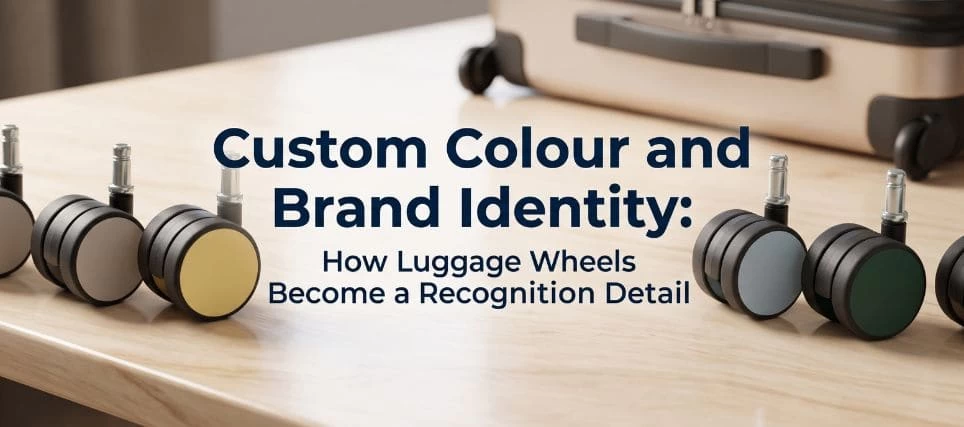
Custom Colour and Brand Identity: How Luggage Wheels Become a Recognition Detail
|
Summary: Luggage is one of the few products seen from the side in stores, airports, and social photos alike — and the wheels sit at the lowest point of that view while being among the least obstructed. Custom colour is a low-cost way to extend brand identity to that position, but three technical hurdles come first: pigment dispersion, batch-to-batch colour management, and — most critically — whether colouring compromises the bond between tread and core. |
Why the Wheels Rather Than the Handle or Lining H2
Brand identity budgets are always finite, so where you spend matters more than how much.
Luggage has a characteristic most products lack: it is almost always seen from the side. In a store it stands on the floor, and shoppers pass it side-on. In an airport it is towed, and what bystanders see is the side and underside. In social photos, travellers shoot it from the side too.
From that angle the wheels sit at the lowest point of the sightline — but precisely because they are at the base, they are almost never obstructed. The front face may be covered by stickers, straps or a hand. The wheels are not.
And in cost-leverage terms, wheels are the cheapest component on the case to change colour. Changing shell colour involves tooling and finishing adjustments; changing the handle involves anodising or coating processes. A wheel needs only a different masterbatch. It is the best ratio of investment to visual return available.
Three Common Approaches to Brand Identity H2
|
Approach |
Visual Effect |
Suits |
Watch For |
|
Matched to shell colour |
Strong cohesion, clean lines |
Minimal design, monochrome premium lines |
Tightest colour tolerance; shell and wheel are different materials, so matching is difficult |
|
Brand colour (contrasting) |
Highest recognisability, strongest in catalogue photography |
Mid-to-upper tier brands with a defined palette |
Confirm behaviour under different lighting, especially fluorescent and high-chroma colours |
|
Two-tone (tread and housing differ) |
Layered, refined detail |
Design-led, talking-point products |
Involves matching two components; longer development lead time |
|
Transparent or translucent tread |
Technical, material-forward look |
Statement series, collaborations |
Transparent material has very low tolerance for contamination and flow marks; yield is challenging |
|
Laser-etched or embossed housing marking |
Understated and durable, independent of colour |
Suits every tier |
Confirm legibility after wear |
The most underestimated in practice is the first — matching the shell. It sounds simplest but is the hardest match, because the shell (usually PC or ABS) and the tread (PU) are different materials, and the same colour reference will not present identically on both. If you take this route, sample both materials together during development rather than matching each separately.
Hurdle One: Pigment Dispersion H2
Uneven dispersion produces cloudiness, streaking or patchy tone on the tread. It should be caught during pre-production trials — but there is a trap: small trial batches mix thoroughly because volume is low, so the defect often does not appear until mass production changes the mixing conditions.
Acceptance practice: require pre-production trial samples produced under mass production conditions, not laboratory-scale batches. Inspect under both daylight and artificial lighting, since certain dispersion defects only become obvious at particular colour temperatures.
Dark tones — black, charcoal, navy — tolerate dispersion variation well. Light and high-chroma colours — white, cream, fluorescent — expose it most readily. If your brand colour falls into the latter group, bring yield into the pricing discussion early.
Hurdle Two: Batch-to-Batch Colour Management H2
This is where long-term supply most often goes wrong.
The first shipment looks right; the replenishment six months later shows visible colour variation. The result is the same model appearing in inconsistent colours on a retail shelf, or a replacement wheel that clearly does not match the originals. The damage to brand perception often outlasts that of a one-off quality issue.
The remedy is to write colour management into the contract, covering three things:
- Agree a ΔE colour tolerance. A measurable figure is far more effective than "colours must match". The specific value should be negotiated by product tier — premium lines usually demand tighter tolerance.
- Agree master plaque retention. Both parties keep a signed-off master colour plaque as the reference in any future dispute, with agreed retention period and update conditions.
- Agree measurement conditions. Colour measurement is affected by light source and viewing angle, so specify instrument conditions and illuminant standard — otherwise two reports cannot be compared.
One further point on light colours: yellowing resistance. White, cream and light grey can yellow under sustained daylight, and luggage spends considerable time outdoors and on aprons. If your brand colour is light, request UV-stabilised formulation options and accelerated ageing data.
Hurdle Three: Does Colouring Affect Durability? H2
This is the most critical question and the one most often answered vaguely. The answer depends on the process.
In conventional two-step bonding, the core is moulded first and the PU tread attached with adhesive. Adding pigment to the PU can interfere with adhesion, so coloured versions may peel from the edge earlier than natural ones. That has a genuine physical basis — and it is why many suppliers exclude customised items from warranty outright.
From a brand's perspective, what that exclusion really means is that all colour-related risk has been transferred to you. You pay the development cost for brand identity, and simultaneously absorb both a higher failure rate and the absence of warranty protection.
But the trade-off is not inevitable. In the One-Time Injection process, PU is moulded directly over the core in a single process and pigment is blended uniformly at the PU injection stage — with no bearing on the bond between tread and core, because the structure contains no adhesive-dependent interface at all.
So at RFQ, ask directly: "At which process stage is pigment introduced?" and "Do custom colours carry the same warranty terms as standard?" The answer to the second usually reveals the first honestly. Warranty conditions for the Enjoy Caster luggage wheel line are [warranty terms TBC].
The Custom Colour Development Workflow H2
|
Stage |
What to Complete |
Common Sticking Point |
|
1. Colour definition |
Supply Pantone reference or physical swatch; if matching the shell, supply a shell sample too |
Supplying only an on-screen swatch, producing material rendering mismatches |
|
2. Masterbatch assessment |
Supplier assesses whether new masterbatch development is needed, plus feasibility and MOQ |
Special effect colours (metallic, pearlescent, fluorescent) not disclosed early |
|
3. Colour matching samples |
Produce matching samples and confirm under a specified illuminant |
No agreed light source, so each party judges separately |
|
4. Production-condition trial |
Trial mould under mass production conditions and inspect dispersion |
Only laboratory-scale batches run; cloudiness appears after production starts |
|
5. Master plaque sign-off |
Both parties sign off and retain a master colour plaque |
Step skipped, leaving no reference for later disputes |
|
6. Contract terms |
Write in ΔE tolerance, measurement conditions, and whether warranty covers customised items |
The customised-item warranty exclusion goes unnoticed |
Overall development lead time and minimum order quantity depend on colour complexity and whether new masterbatch development is required; current conditions are [MOQ and lead time TBC]. We recommend starting the conversation three to four months before design freeze so colour never becomes the bottleneck before production.
Frequently Asked Questions H2
Q1: Do custom-colour luggage wheels fail sooner than standard ones? H3
It depends on the process. With two-step bonding, they can, because pigment may interfere with adhesion between PU and core — which is why many suppliers exclude customised items from warranty. With one-time injection they do not, because pigment is blended at the PU injection stage and the structure has no adhesive-dependent interface. Confirm the pigment introduction stage at RFQ.
Q2: How is batch-to-batch colour variation controlled? H3
Agree three things contractually: a ΔE colour tolerance (a measurable figure, far more effective than "colours must match"), master plaque retention by both parties, and measurement conditions covering instrument and illuminant standard. Without the third, two colour reports cannot be compared.
Q3: How difficult is matching the wheels to the shell colour? H3
Harder than it sounds. Shells are usually PC or ABS while treads are PU, and the same colour reference will not present identically across different materials. Sample both materials together during development rather than matching each separately, and judge jointly under a specified illuminant.
Q4: Will light-coloured luggage wheels yellow? H3
They can. White, cream and light grey may yellow under sustained daylight, and luggage spends considerable time outdoors and on aprons. If your brand colour is light, request UV-stabilised formulation options and accelerated ageing data.
Q5: How long does custom colour development take, and what is the MOQ? H3
It depends on colour complexity and whether new masterbatch development is needed. Standard ranges are usually matched faster; specific Pantone references or metallic, pearlescent and fluorescent effects require sampling and take longer. Start the conversation three to four months before design freeze. Contact us for specific conditions.
Conclusion & Next Step H3
Within a price band, shell materials, handle structures and lock specifications have become highly homogeneous. The three-second judgement a shopper makes in a store usually lands on details that need no explanation to be felt.
Wheel colour is exactly that kind of detail — cheap enough to overlook, yet present in every product photograph and every airport walk.
On one condition: colour should not be paid for in durability. And that comes down to which process your supplier uses.
- Send us your colour references: we will assess feasibility, MOQ and development lead time and produce preliminary samples. If matching the shell, please include a shell sample.
- Request a sectioned sample: confirm whether colouring affects the structure — in an integrated structure, custom colour and standard are structurally identical.
- Request a custom colour sample set: physical samples are more accurate than any on-screen swatch, and we will ship pieces matched to your brand palette.
Enjoy Caster | Enjoying Go Co., Ltd. | www.enjoycaster.com | Patented One-Time Injection technology
About the Author H3
Rita Lai | Sales Manager, Enjoying Go Co., Ltd. (Enjoy Caster). She leads international B2B business development for caster products, working with office furniture, medical equipment, logistics and industrial equipment manufacturers, and handles front-line technical discussions at international trade fairs including ORGATEC, MEDICA, and the Taiwan Int'l Tools & Hardware Expo. The failure diagnosis methods and procurement guidance in this article are drawn from actual client projects.
About Enjoy Caster: Enjoying Go Co., Ltd. is a Taiwanese caster manufacturer whose core technology is the patented One-Time Injection process, which resolves PU caster delamination at the manufacturing level. Products meet BIFMA standard requirements and hold SGS, RoHS, REACH, and PCR certifications. The full range, including custom colours, carries a 5-year warranty. www.enjoycaster.com