
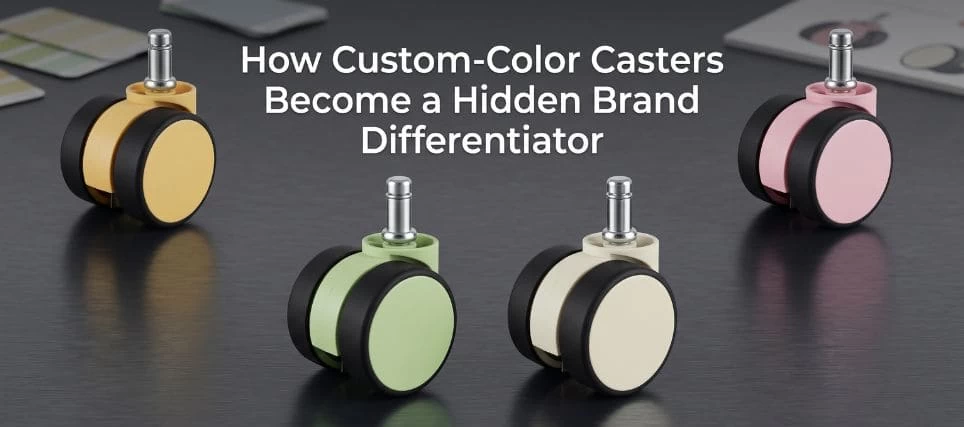
How Custom-Color Casters Become a Hidden Brand Differentiator: An OEM Buyer's Guide to Colour Customization
Introduction: The Three Questions Brands Ask Most
Question 1: "Can a custom color caster really deliver brand differentiation, or does it just look nice?" It genuinely can — and it is the lowest unit-cost differentiation lever anywhere on a chair. Customising the colour of a backrest, armrest or upholstery means significant tooling and supply chain changes. A caster needs only a different masterbatch to place a brand signal at the lowest point in the user's sightline and the most continuously touched surface of the product.
Question 2: "Does colour cost me durability?" With conventional two-step bonding, yes. Adding pigment can interfere with adhesion between the PU tread and the core — a trap many OEM buyers have fallen into: beautiful colour, delamination within six months. With one-time injection moulding, the PU and core bond within a single process, so pigment does not weaken the structure. Colour and durability stop being a trade-off.
Question 3: "What about MOQ and lead time?" It depends on colour complexity and whether new masterbatch development is required. Standard ranges can usually be matched quickly; specific Pantone references or metallic and pearlescent effects need sampling and confirmation. We recommend starting the conversation 3–4 months before design freeze so colour never becomes the bottleneck before mass production.
1 | Why Colour Is the Cheapest, Most Visible Differentiation Lever
In office furniture and commercial equipment, visual homogeneity is extreme. Within any given price band, task chairs share ergonomic architecture and mesh materials so closely that neither end users nor B2B buyers can tell them apart in a catalogue. Which makes details the actual battleground.
- Sightline advantage: seated, the user's natural gaze sweeps across the caster base; standing, casters are among the first components noticed when entering an office.
- Cost leverage: compared with the tooling and finishing cost of changing shell colour, the marginal cost of a caster colour change is minimal — yet it shifts the visual impression of the whole chair.
- Spatial identification: for workplace planners, using caster colour to distinguish departments, floors or functional zones is an extraordinarily cheap visual management tool.
- Photography and marketing: in brand imagery, casters matched to the brand palette measurably lift the recognisability of an entire product shoot.
This is why a growing number of design-led European brands now treat OEM custom-colour casters as a standard option in new product development rather than a paid extra.
2 | Three Technical Hurdles in Colour Customization (and How to Inspect for Them)
Colour sounds simple. In practice there are hurdles that are consistently underestimated. Here they are, formatted as an inspection checklist you can use directly:
|
Technical Hurdle |
What Goes Wrong |
How to Inspect |
|
1. Masterbatch dispersion |
Uneven pigment dispersion creates cloudiness, streaking or patchy tone — usually discovered only after mass production. |
Require pre-production trial samples and inspect under both daylight and artificial lighting. |
|
2. Batch-to-batch colour variation |
The first shipment and the three-month replenishment differ visibly, leaving one office with mismatched chairs. |
Agree a ΔE tolerance in writing and retain a master colour plaque as the reference in any dispute. |
|
3. Pigment vs. bond strength |
In bonded processes, pigment can compromise adhesion, so coloured wheels delaminate earlier than natural ones. |
Ask at which process stage pigment is introduced, and request durability data for the coloured version specifically. |
|
4. Weathering and yellowing |
Light tones (white, cream, light grey) can yellow under sustained daylight, damaging brand perception. |
Require UV-stabilised formulation options and accelerated ageing data for light colours. |
|
5. Non-marking performance |
Dark treads leaving roll marks on light flooring is a routine source of end-user complaints. |
Require non-marking test evidence on your specified floor material. |
Item 3 is the decisive one. If your supplier uses two-step bonding, colour and durability are a zero-sum trade-off. With one-time injection, pigment is blended uniformly at the PU injection stage and the core-to-tread bond depends on no adhesive whatsoever — so the "coloured version fails sooner" problem simply does not exist.
3 | The Enjoy Caster Approach: Colour Freedom Without a Durability Penalty
|
Criterion |
Conventional Bonded Custom Colour |
Enjoy Caster One-Time Injection Custom Colour |
|
Pigment introduction stage |
Coloured before bonding, potentially affecting the adhesive interface |
Coloured during PU injection, structurally irrelevant to bond strength |
|
Durability of coloured version |
Often lower than the natural-colour version |
Identical to the natural-colour version |
|
Batch consistency |
Subject to both adhesive and pigment variables |
Single process, fewer variables |
|
Warranty coverage |
Custom colours are frequently excluded from warranty |
Custom colours carry the same 5-year warranty |
|
Documentation available |
Varies by supplier |
SGS, BIFMA, RoHS, REACH and PCR document pack |
The last two rows deserve emphasis. Many suppliers exclude customised items from warranty coverage, which effectively transfers all colour-related risk to the brand. Our position is straightforward: since the one-time injection process is not weakened by pigment, there is no justification for excluding custom colours from the 5-year warranty.
4 | ORGATEC Cologne 2026: The Colour Wall and On-Site Matching
ORGATEC Cologne 2026 runs 27–30 October 2026 at Koelnmesse in Cologne, Germany. For brand designers and OEM buyers we are running two services on the stand:
- The custom colour wall: physical one-time injection casters across our colour ranges, so you can compare under daylight and hall lighting rather than judging a swatch on a screen.
- On-site colour matching consultation: bring your brand colour references (Pantone or physical samples) and our engineers will give you a preliminary read on feasibility, development lead time and MOQ — so you can move straight to quotation when you get home.
If you are planning a 2027 product line, send your colour references before the show. We can have preliminary samples ready for you to inspect during the fair, compressing what is normally a two-month exchange into a single meeting.
Conclusion & Call to Action: Let the Smallest Component Tell the Whole Brand Story
The custom-color caster is a hidden differentiator precisely because it is cheap enough to overlook, yet sits at the point users touch most often. While competitors are still comparing mesh specifications, a set of casters matched exactly to your brand palette has already done quiet work on recognition.
On one condition: colour must not come at the cost of durability. That is the value of one-time injection technology — the brand gets the colour it wants, engineering gets a structure that will not delaminate, and procurement gets a 5-year warranty that covers customised items.
Take action:
- Send us your colour references: we will assess feasibility, MOQ and development lead time, and produce preliminary samples.
- Request a custom colour sample set: physical samples are more accurate than any swatch — we will ship pieces matched to your brand palette.
- Book on-site colour matching at ORGATEC Cologne 2026: 27–30 October, Koelnmesse, Cologne. Pre-booking recommended.
Enjoy Caster | Enjoying Go Co., Ltd. | www.enjoycaster.com | Custom colours carry the same patented One-Time Injection technology and 5-year warranty.