
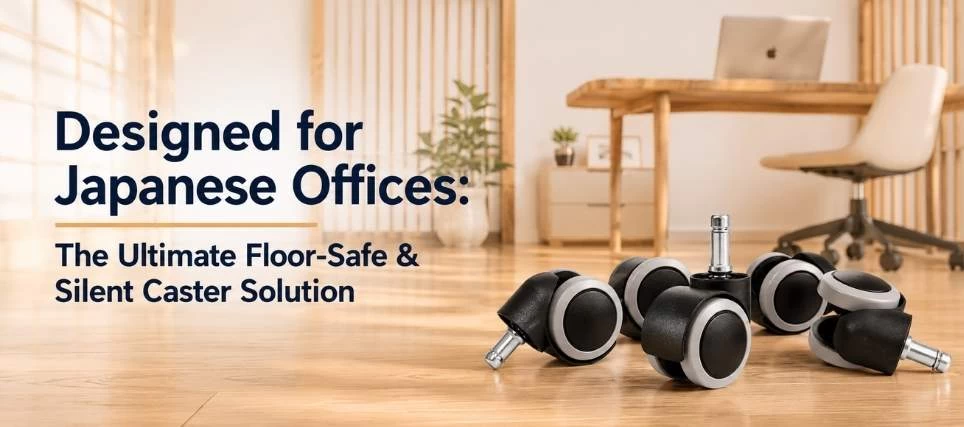
In Japanese office spaces, the silent expectations placed on a caster far exceed what most markets would ever consider.
When a Japanese office designer or procurement manager selects an office chair, the questions running through their mind are rarely about comfort alone:
- Will the sound of moving the chair disturb colleagues in the middle of a meeting?
- Will the wood floor show pressure marks or grooves after a year of use?
- Does the chair glide with minimal effort — no resistance, no stick-slip?
These three questions define the core requirement matrix of Japan's office caster market. Enjoying Go engineers every product in this line to answer all three.
Why Japanese Office Culture Places Unique Demands on Casters
1. The Dominance of Open-Plan Office Layouts
Japanese companies widely adopt open-plan office configurations — close desk spacing, no partitions, and acoustic conditions where any sound travels fast. The rolling noise of casters on wood or wood-finish flooring is amplified significantly in these environments. Silent casters in Japan are not a comfort feature — they are a matter of professional courtesy.
2. Premium Wood and Wood-Finish Flooring Is the Norm
Japanese office spaces — especially executive offices, boardrooms, and premium commercial interiors — widely specify solid wood or high-quality wood-finish flooring. These surfaces represent significant per-square-meter investment. Scratches or pressure indentations mean expensive repairs. Floor protection is consistently the highest-priority unstated requirement in any caster specification.
3. Ergonomics Awareness at the Highest Level
Japan is one of the world's most advanced markets for ergonomic office furniture. Rolling resistance has a direct impact on the physical load placed on users during daily office movement — especially for those spending extended periods seated. A caster that glides with one-finger force is not a luxury: it is the baseline expression of human-centered design.
Japan Office Requirements vs. Enjoying Go Solutions
|
Evaluation Criteria |
Japan Office Standard |
Enjoying Go Solution |
|
Floor Protection |
No impressions, scratches, or discoloration on wood floors; wheel hardness must be lower than floor surface hardness |
Floor-safe PU formulation with precision Shore hardness control and optimized contact geometry |
|
Noise Level |
Rolling noise during office hours must fall below ambient background — no disruption to meetings or focused work |
Low-noise PU composite material with simultaneous vibration and acoustic damping |
|
Rolling Smoothness |
One-finger push force, zero stick-slip, ergonomically optimized for daily use |
Precision bearing design + core geometry optimization for minimal starting resistance |
|
Load Stability |
Zero wobble when stationary, even load distribution, no deformation over long-term use |
High-rigidity core body with load structure verified against BIFMA standard |
|
Cleanability |
No dust accumulation in wheel gaps, no hair adhesion on wheel surface, zero-effort maintenance |
Smooth wheel surface + anti-accumulation core gap design for effortless daily cleaning |
Deep Dive 1: The Engineering Behind Floor-Safe Casters
Floor protection sounds straightforward. In practice, it requires precise material and structural decisions across multiple dimensions.
Precision Shore Hardness Control
A wheel material that is too hard acts like rolling a pebble across the floor — even light contact leaves marks. Enjoying Go's floor-safe PU casters use a formulation with precision-controlled Shore hardness, ensuring the wheel material is consistently softer than common wood floor surface hardness — eliminating the mechanical cause of scratching at its source.
Wheel Contact Geometry Optimization
The shape of the wheel tread directly determines contact area and pressure distribution against the floor. Enjoying Go optimizes the tread radius for office-environment casters to distribute contact pressure over a larger surface area, eliminating localized stress concentration — the key structural factor in preventing pressure indentation.
|
Design Reference |
Floor-safe PU casters for wood surfaces are generally specified at Shore A 65 or below to ensure no-damage contact with common hardwood floors (oak, beech). Contact us for application-specific technical specifications. |
Deep Dive 2: The Acoustic Engineering of Near-Silent Rolling
Silent caster is not a marketing claim — it is a quantifiable, engineerable physical outcome. The two primary sources of caster noise are:
- Wheel-to-floor contact vibration: Harder materials with smaller contact areas generate higher-impact vibrations that transmit as sound.
- Bearing mechanical noise: Low-precision bearings produce high-frequency metallic resonance during rolling.
Enjoying Go addresses both sources simultaneously:
Low-Noise PU Composite Wheel Material
Our PU composite formulation achieves an optimal balance of Shore hardness and damping coefficient — the material's ability to absorb and dissipate vibrational energy rather than transmitting it as sound. Every rolling contact is silently absorbed rather than amplified by the floor surface.
Precision Bearing Design
Enjoying Go casters use precision bearing specifications that minimize mechanical noise during rolling. Bearing material selection and tolerance grade directly determine whether a caster maintains its acoustic performance across its full service life — a key component of our long-term quality consistency commitment.
|
Industry Reference |
An informal benchmark for office caster noise performance: rolling the chair should be inaudible to a person seated 1 metre away. Contact us to request our acoustic test report data. |
Deep Dive 3: One-Finger Glide — Ergonomic Rolling Design
Low rolling resistance is not only a comfort feature — it is a workplace health issue. Long-term use of high-resistance casters causes users to unknowingly exert force during repositioning, accumulating extra load on the lower back and legs over the course of a workday.
Enjoying Go's low-starting-resistance design allows chairs to glide with near-zero effort, systematically reducing the physical burden of daily office movement.
Three Office Environment Applications
|
Open-Plan Office High-frequency chair movement across shared spaces. Silent casters mean repositioning stays invisible — no disruption to the team's focus. |
Conference Room High-level meetings demand absolute quiet. Chair movement sounds cut through silence with disproportionate impact. Low-noise casters are a prerequisite for a composed, professional setting. |
Executive Office Premium wood flooring is standard in executive spaces. Imported hardwood floors represent significant investment — floor-safe casters are the most cost-effective long-term protection. |
The Bottom Line
Japan's demands on office casters may appear exacting — but they follow a clear and principled logic: every detail done right is an act of respect for the people using the space and the space itself.
Enjoying Go commits to floor safety and near-silent rolling as the twin pillars of our Japan office caster line, backed by engineering specifications and third-party certifications — because we believe the best caster is the one you never notice.
Visit us at ORGATEC TOKYO 2025. Roll one of our casters across the floor yourself — that quiet glide is the most honest product demo we can offer.