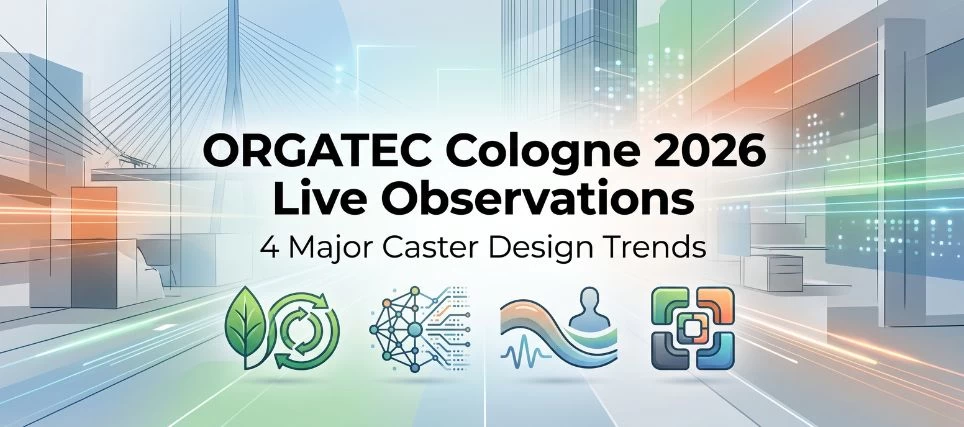
ORGATEC Cologne 2026 Live Observations: 4 Major Caster Design Trends
|
Summary: ORGATEC Cologne 2026 runs 27–30 October at Koelnmesse. Walking the halls, caster-related design discussion falls into four directions: structural integration replacing dissimilar-material bonding, colour shifting from functional accessory to brand identity, mixed flooring driving universal selection thinking, and design for disassembly with recycled content becoming standard. Each is unpacked below, with specific recommendations for 2027 development. |
Trend One: Structural Integration Replaces Dissimilar-Material Bonding H2
This was the clearest thread running through the halls.
For the past decade, office furniture component design has favoured modularity — different materials each doing their job, assembled through joining methods. But as complete-chair warranties extended from two years to five or even ten, the cost of that approach surfaced: the interface between dissimilar materials is always the first thing to fail.
In casters, the problem is especially visible. Conventional PU casters are made by two-step bonding: the core is moulded first, then the PU tread is attached with adhesive or mechanical keying, leaving a bond line between them. When a user drags a chair sideways, or equipment is pushed repeatedly across carpet, shear stress concentrates at the tread edge, and the adhesive layer peels inward. That is delamination.
The shift visible on the floor is that brands have started asking how many joining interfaces a component contains, rather than only what it is made of. Enjoying Go Co., Ltd.'s (Enjoy Caster) patented One-Time Injection technology is the concrete expression of this trend — PU moulded directly over the core within a single process, producing one integrated body with no bond line and therefore no peel initiation point.
Trend Two: Colour Moves From Accessory to Brand Identity H2
The second clear change is visual.
Casters were once almost universally black or grey — a component that had to exist but was not meant to be seen. This edition featured a great many exhibits treating the base and casters as colour surfaces: some matched to the shell for visual unity, some deliberately contrasting as a brand marker.
The logic is practical. Within a price band, task chair ergonomics and mesh materials are now highly homogeneous, and designers need recognisability in catalogue photography. The caster is the highest-leverage position available — compared with the tooling and finishing cost of changing shell colour, a masterbatch change is marginal.
The trade-off deserves attention. In two-step bonding, pigment can interfere with adhesion, so coloured versions may delaminate earlier — which is why many suppliers exclude customised items from warranty. In one-time injection, pigment is blended at the PU injection stage and has no bearing on structural strength, which is why we cover custom colours under the same 5-year warranty as standard.
Trend Three: Mixed Flooring Drives Universal Selection Thinking H2
The third trend comes from a change in the usage environment.
With hybrid work established, one batch of chairs may sit simultaneously on carpet tile at headquarters, wood flooring in a co-working space, and tile or LVT in an employee's home. The traditional approach — select hardness according to the customer's floor material — breaks down, because there is no single floor material to follow.
Two responses were visible on the floor. One is increasing wheel diameter, using geometry to reduce dependence on hardness (a larger wheel sinks less into carpet and rolls more smoothly on hard surfaces). The other is adopting a compromise hardness while strengthening non-marking performance, so nothing shows even on the most unforgiving pale LVT.
For 2027 development, this means specifications should state acceptable performance across multiple flooring scenarios, rather than optimal performance on one.
Trend Four: Disassembly and Recycled Content Move From Bonus to Baseline H2
The fourth trend is sustainability becoming concrete.
The EU circular economy framework brings repairability and component replaceability into product design, with office furniture among the priority categories. On the floor, that shows up as more brands labelling material composition and recycled content beside exhibits, rather than hanging a green slogan above them.
There are two practical consequences for component suppliers. First, PCR (post-consumer recycled) certification is now requested, and buyers will press on whether it is PCR or in-house PIR scrap — because most ESG reporting frameworks recognise only PCR. Second, durability is being redefined as environmental performance: double the service life, and you halve manufacturing volume, transport emissions and waste. That is a favourable narrative for suppliers willing to underwrite longevity with a long warranty.
The Four Trends and What to Write Into 2027 Specifications H2
|
Trend |
Design Implication |
What to Put in the 2027 Specification |
|
Structural integration |
Fewer dissimilar-material interfaces, lower long-term failure rate |
Require an explanation of the joining process; request a sectioned sample to confirm whether a bond line exists |
|
Colour as identity |
Casters become part of product identity rather than an invisible part |
Confirm custom colours are warranted; agree a ΔE colour tolerance for replenishment batches |
|
Mixed flooring |
Single-floor selection fails; a universal solution is needed |
State acceptable performance across multiple flooring scenarios, not one optimum |
|
Sustainability and disassembly |
Recycled content and service life become auditable metrics |
Require PCR certification (distinguished from PIR), RoHS, REACH, and durability evidenced by warranty length |
Note that the four trends are interrelated. Structural integration simultaneously serves durability (trend one), colour freedom (trend two) and sustainability (trend four) — which is why we regard process-level decisions as more worth investing in than any single material specification.
Frequently Asked Questions H2
Q1: What are the dates and venue for ORGATEC Cologne 2026? H3
27–30 October 2026, daily from 09:00 to 18:00, at Koelnmesse in Cologne, Germany.
Q2: What does "structural integration" mean for a caster? H3
It means reducing discrete joining interfaces between dissimilar materials. For PU casters, conventional two-step bonding moulds the core and tread separately, then bonds them, leaving an adhesive layer. Integration moulds PU directly over the core in a single process, with no discrete adhesive layer and therefore no peel initiation point.
Q3: Does a custom colour make a caster more likely to fail? H3
It depends on the process. With two-step bonding, it can, because pigment may interfere with adhesion. With one-time injection, it does not, because pigment enters at the PU injection stage and has no bearing on structural strength. Buyers should confirm directly whether customised items fall within warranty coverage.
Q4: How should I select tread hardness for mixed flooring? H3
The rule is hard floors take softer treads and soft floors take harder treads, but mixed environments have no single answer. The practical approach is a compromise hardness with increased wheel diameter, plus non-marking and rolling test evidence across every floor material your product will encounter — not the optimum for one surface.
Q5: What is the difference between PCR and PIR, and why do buyers ask? H3
PCR is post-consumer recycled material, reclaimed after end-user use. PIR is post-industrial scrap reprocessed within the factory. Most ESG reporting frameworks recognise only PCR as genuine circular recovery, so the two cannot be used interchangeably and buyers have to confirm which they are getting.
Conclusion & Call to Action: Turn a Trend Into One Line of Specification H3
The value of a trend report is not knowing what happened — it is whether it can be written into the next revision of your specification. All four trends converge on a single question: does your caster supplier solve problems at the material level, or at the process level?
- Request a sectioned sample: ten seconds to confirm whether the structure is integrated — the fastest way to judge delamination risk.
- Request test samples: send the flooring materials and load conditions you need to cover, and we will match specifications and ship.
- Meet us in Cologne: we are at ORGATEC 27–30 October as visitors, not exhibitors. Arrange a time and bring brand colour references or failed samples for on-the-spot assessment.
Enjoy Caster | Enjoying Go Co., Ltd. | www.enjoycaster.com | Patented One-Time Injection technology, with a 5-year warranty across the range including custom colours.
About the Author H3
Rita Lai | Sales Manager, Enjoying Go Co., Ltd. (Enjoy Caster). She leads international B2B business development for caster products, working with office furniture, medical equipment, logistics and industrial equipment manufacturers, and handles front-line technical discussions at international trade fairs including ORGATEC, MEDICA and the Taiwan Int'l Tools & Hardware Expo. The failure diagnosis methods and procurement guidance in this article are drawn from actual client projects.
About Enjoy Caster: Enjoying Go Co., Ltd. is a Taiwanese caster manufacturer whose core technology is the patented One-Time Injection process, which resolves PU caster delamination at the manufacturing level. Products meet BIFMA standard requirements and hold SGS, RoHS, REACH, and PCR certifications. The full range, including custom colours, carries a 5-year warranty. www.enjoycaster.com