
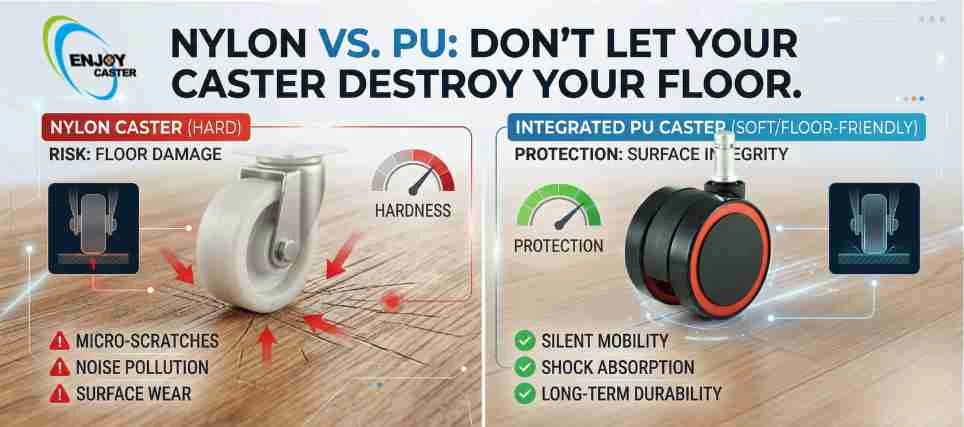
Are Nylon Casters Really Better? The Critical Link Between Material and Floor Integrity
When selecting casters, many procurement managers pivot toward Nylon (Polyamide) wheels under the assumption that they are the "safer" and more durable choice.
The logic is often a reaction to past failures: Nylon does not suffer from hydrolysis (peel-off), offers high structural rigidity, and supports heavy loads. However, focusing solely on the caster's durability while ignoring floor compatibility is a common strategic error.
At Enjoying Go, we believe material selection should start with the floor surface, not the hardware.
1. The Rigid Strength of Nylon: A Double-Edged Sword
Nylon casters are industrial powerhouses. With a high Shore D hardness rating, they offer minimal rolling resistance and excellent chemical resistance. This makes them ideal for:
-
Heavy Industrial Hubs: Warehouses and factories.
-
Rough Surfaces: Unfinished concrete or asphalt.
The Catch: Because Nylon is a high-modulus, rigid material, it does not absorb vibration or impact. On finished indoor flooring, this rigidity turns into an aggressive force.
2. The Overlooked Risk: Floor Damage & Surface Wear
Using hard Nylon wheels on delicate surfaces creates a high Point Loading effect. Over time, this results in:
-
Micro-scratches: Ruining the aesthetic of high-end hardwoods and laminates.
-
Noise Pollution: High-frequency vibration that disrupts office and healthcare environments.
-
Coating Failure: Stripping away specialized floor finishes or wax layers.
In these scenarios, the "durability" of the Nylon wheel is irrelevant if it costs the client thousands in floor restoration.
3. Why Engineered PU is the Balanced Choice for Indoors
PU (Polyurethane) casters are designed to act as a bridge between the load and the floor. By utilizing a lower durometer (usually Shore A range), PU provides:
-
Shock Absorption: Protecting both the equipment and the floor from impact.
-
Silent Mobility: Essential for 2026's open-plan offices and acoustic-sensitive workspaces.
-
Superior Grip: Preventing "skidding" on polished tiles or vinyl.
4. The Trade-Off: Shifting the Risk
A frequent procurement mistake is choosing Nylon simply to avoid "PU peel-off" issues. However, if the PU failure was caused by poor manufacturing, switching to Nylon doesn't solve the problem—it simply shifts the risk from the caster to the floor.
The real solution is not switching materials, but choosing an Integrated PU Caster (like our One-Time Injection models) that offers the durability of Nylon with the floor protection of PU.
Decision Matrix: Nylon vs. PU
| Environment | Recommended Material | Priority |
| Warehouse / Concrete | Nylon | Load Capacity & Durability |
| Office / Hardwood | PU | Floor Protection & Noise |
| Healthcare / Lab | Medical-Grade PU | Hygiene & Silent Operation |
| Retail / Polished Tile | Non-Marking PU | Aesthetics & Surface Grip |
Engineering for the Entire System
Nylon is not "better" than PU, and PU is not "inferior" to Nylon. They are different tools for different surfaces.
Before your next procurement cycle, don't just ask, "Will the caster last?" Ask, "Will the floor survive?" For most indoor commercial applications, a high-quality, integrated PU caster remains the superior choice for Total Cost of Ownership (TCO).