
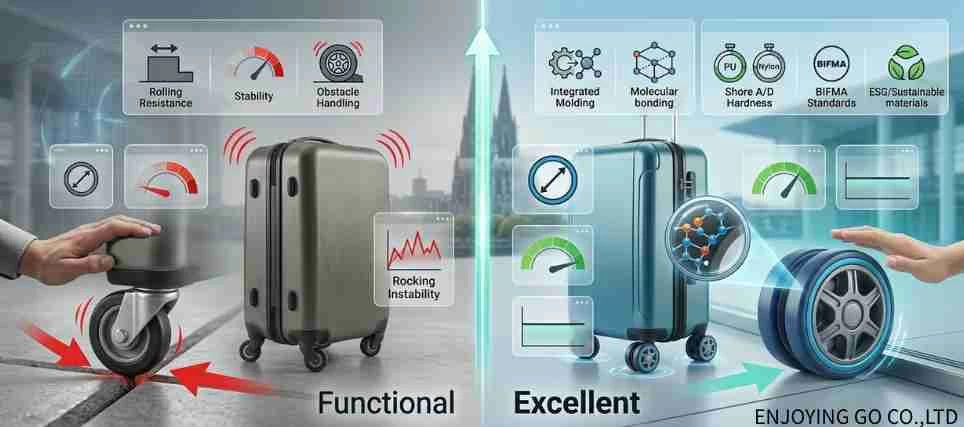
Why Modern Luggage Uses Larger Dual Wheels: The Engineering of Effortless Mobility
When walking through international airports today, a clear technological shift is visible: older suitcases with small, single wheels are being replaced by luggage featuring larger-diameter dual-wheel designs. This evolution isn’t just a design trend—it’s an engineering response to the physics of Rolling Resistance, Stability, and Obstacle Handling.
1. The Physics of Rolling Resistance ($F = \mu \times W/R$)
The most significant benefit of a larger wheel diameter is the reduction of rolling resistance.
-
Mechanical Advantage: Physics dictates that as the radius ($R$) of the wheel increases, the force ($F$) required to overcome friction decreases.
-
Energy Efficiency: Larger wheels suffer less deformation at the contact patch, meaning less energy is lost as heat.
-
The Result: For the traveler, this translates to a "light-push" feel, even when the suitcase is at maximum capacity.
2. Stability and Lateral Support: The Dual-Wheel Advantage
Why two wheels instead of one? The transition to Twin-Wheel (Dual-Wheel) configurations addresses the issue of weight distribution and balance.
-
Increased Contact Patch: Dual wheels distribute the load over a wider surface area, reducing the pressure on any single point of the floor.
-
Reduced Wobbling: A wider "track width" on each caster unit minimizes side-to-side rocking, especially during high-speed walking or sharp turns.
-
Pivot Accuracy: Twin wheels allow for smoother $360^{\circ}$ rotation with less friction, providing a more controlled navigation experience.
3. Obstacle Handling: Improving the "Attack Angle."
Real-world surfaces—tile gaps, plush carpets, and elevator thresholds—are the enemies of small wheels.
-
Better Attack Angle: A larger wheel meets an obstacle at a shallower angle, allowing it to "climb" over the gap rather than getting stuck.
-
Shock Absorption: Larger wheels, often paired with high-grade TPU or Integrated PU materials, absorb micro-vibrations better than small, hard plastic wheels.
4. Total Cost of Ownership: Durability vs. Convenience
From a procurement and user perspective, the shift to larger dual wheels represents a move toward Total Cost of Ownership (TCO) value.
-
Lower RPM: Larger wheels rotate fewer times to cover the same distance, significantly extending the lifespan of the bearings and the tread.
-
Silent Operation: High-quality dual wheels are engineered for acoustic comfort, a baseline requirement for modern premium travel gear.
5. Beyond Luggage: A Universal Standard for Mobility
The engineering principles driving luggage evolution are the same ones we apply to Medical Casters, High-End Office Chairs, and Industrial AGVs. Whether it is a suitcase in an airport or a mobile workstation in a hospital, the goals remain consistent: Minimize resistance, maximize stability, and ensure floor protection.