
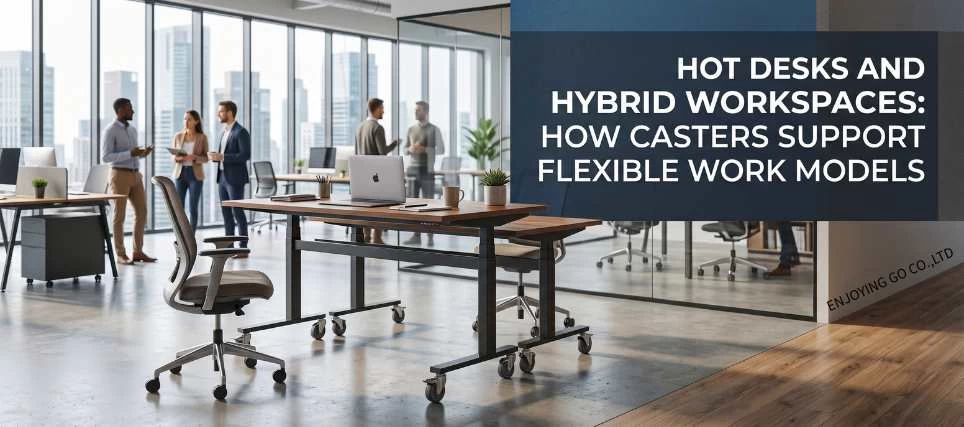
Hot Desks and Hybrid Workspaces: How Casters Support Flexible Work Models
As hybrid work becomes the new standard in the post-pandemic era, hot desking has rapidly expanded across organizations worldwide. The logic behind office design has fundamentally shifted — away from assigned individual workstations and toward high-utilization, highly flexible shared environments. In this context, the mobility of office furniture has become a critical requirement, and the caster wheel is the unsung component making it all possible.
This article explores how hot desk and hybrid workspace trends are reshaping caster specifications — and how Enjoy Caster's PU casters address these demands with engineering-grade precision.
1. What Is Hot Desking? The New Standard in Flexible Workplaces
Hot desking is a non-assigned seating model in which employees choose from available workstations each day, rather than occupying a dedicated seat. Combined with hybrid work policies — where employees split time between the office and remote locations — this approach requires office furniture to be reconfigured frequently and efficiently.
The operational implications are significant:
- Seat utilization rates climb from 50–60% under traditional layouts to 70–85% in hot desk environments
- Desks, chairs, partitions, and storage units must be repositioned rapidly and regularly
- Spaces must transition between focus zones and collaborative areas within the same day
- Daily sanitization, reorganization, and reset cycles place constant demands on furniture durability
The conclusion is straightforward: office furniture must move easily — without damaging floors or generating disruptive noise.
2. Core Mobility Requirements in Hybrid Office Design
Space flexibility is a primary metric in hybrid workspace design. Facility managers and procurement decision-makers consistently evaluate furniture mobility against the following criteria:
|
Requirement |
Detail |
|
Floor Protection |
No scratching of hardwood, tile, epoxy, or polished concrete floors |
|
Silent Operation |
Rolling must generate minimal noise to preserve focus in open-plan offices |
|
Load Capacity & Durability |
Must handle repeated movement of heavy desks, cabinets, and storage units |
|
Aesthetic Compatibility |
Low-profile design that integrates seamlessly into modern interior environments |
|
Compliance & Certification |
Adherence to BIFMA standard, REACH, RoHS, and other international regulations |
3. Why PU Casters Are the Ideal Choice for Hot Desk Environments
Among the various caster materials available, polyurethane (PU) casters have become the preferred choice for office furniture — and for good reason. Their material properties align closely with the performance demands of modern shared workspaces:
Superior Floor Protection
PU has a hardness between hard rubber and nylon, resulting in a smaller contact footprint during rolling. Unlike carbon-black compounds used in some rubber casters, PU does not stain or mark flooring surfaces, making it compatible with hardwood, marble, PVC, and laminate floors.
Quiet Rolling That Respects the Workspace
Compared to PP or hard nylon casters, PU offers significantly better vibration absorption. In open-plan offices, this translates to near-silent furniture movement — preserving the acoustic environment and preventing distractions during collaborative or focused work sessions.
High Load Capacity with Long-Term Wear Resistance
Enjoy Caster's PU casters are produced using an integrated PA Nylon bracket and PU tread injection molding process. This eliminates structural weak points, delivering casters that withstand the dynamic, repeated loads generated by daily hot desk reconfiguration.
Aligned With ESG and Sustainable Procurement
Enjoy Caster's PU casters are SGS-certified and compliant with REACH and RoHS directives. Select models incorporate PCR (Post-Consumer Recycled) materials, supporting organizations with ESG-aligned procurement mandates.
4. Enjoy Caster's Core Technology: Zero Delamination, By Design
A common quality issue in the caster market is wheel face delamination — the separation of the PU tread from the wheel core under sustained load or repeated dynamic stress. This failure mode is particularly problematic in hot desk environments where furniture is moved multiple times daily.
Enjoy Caster's Technical Director, Bruce Yang, holds a proprietary patent for PU injection molding. By chemically and structurally bonding the PA Nylon core and PU tread in a single-shot injection process, Enjoy Caster eliminates the delamination risk at the source.
For procurement managers and furniture OEMs, this means: longer service life, fewer replacement cycles, and lower total cost of ownership.
5. Selecting the Right Office Caster for Hot Desk Furniture
When specifying casters for hot desk applications, procurement teams and furniture designers should evaluate the following parameters:
- Wheel Diameter: 50mm-75mm for standard office desks and chairs; larger diameters for heavy-duty workstations or storage units
- Load Capacity: 60-100 kg per caster recommended; adjust based on furniture weight and usage frequency
- Tread Material: PU for versatile floor compatibility; TPR for softer flooring surfaces
- Brake Function: Locking casters for stationary stability; swivel-only for maximum mobility
- Stem or Socket Specification: Must match furniture base hardware (common specs: M10 threaded stem, 7/16" grip ring stem)
- Certification Requirements: Confirm whether BIFMA standard compliance or EU EN certification is required
6. Conclusion: A Mobile Office Needs a Caster You Can Trust
Hot desking and hybrid workspaces are not just a cultural shift in how people work — they represent a systemic demand for higher-performance office furniture components. A single, well-engineered PU caster quietly enables the entire spatial flexibility that modern organizations depend on.
Enjoy Caster operates under the principle of "Engineered as One, Recycled as One" — integrating engineering precision and sustainable material thinking into every caster we produce. We partner with office furniture manufacturers and commercial project teams worldwide to deliver component solutions that meet the highest B2B quality standards.
To learn more about our caster specifications or request samples, please contact our sales team.